Pages

Showing posts with label Indiana University. Show all posts

Monday, May 18, 2026

Straws in the Wind - Part 346

From the Chronicle of Higher Education: An Indiana University biology professor who has condemned the U.S. government’s prosecution of Chinese scientists now finds himself locked out of his lab amid a federal investigation. The closure of the lab and other research space at the Bloomington campus marks the latest step in months of scrutiny of Chinese researchers and, by extension, American colleagues who have come to their defense.

Neither federal authorities nor the university, whose police department closed the labs on Thursday night, have offered a reason for the lockout, the chair of Indiana’s biology department said. But it came weeks after one of the professor’s postdoctoral students was ordered deported to China for allegedly smuggling biological materials into the United States, a move criticized by the professor, Roger W. Innes.

“It seems pretty obvious that this is an attempt by the current administration to silence people that question their activities,” Innes told The Chronicle.

Meanwhile, the indefinite closure of multiple labs, offices, and storage facilities — many of which have no affiliation with Innes or his lab — has hampered the work of approximately 50 other individuals at Indiana, said the department chair, Armin P. Moczek. And although the university has said it shut down the facilities at the order of the U.S. Department of Agriculture, the department told The Chronicle it had issued no such order...

Full story at https://www.chronicle.com/article/a-professor-defended-a-postdoc-who-was-deported-now-his-lab-has-been-suddenly-locked-down.

Wednesday, March 11, 2026

Straws in the Wind - Part 278

From the Daily Princetonian: University faculty and administrators will consider a proposal to require proctoring for all in-person examinations, which would mark a departure from the traditionally unproctored exam format under the Honor Code. If passed, the policy could take effect as early as next fall, according to Honor Committee members. The proposal was discussed in a meeting between Honor Committee leadership and Dean of the College Michael Gordin on Wednesday, Feb. 25. Although conversations about proctored examinations have been ongoing in recent years, the new policy is now set to enter a multi-stage faculty and administrative review before it can come to a vote by the faculty. Currently, only individual and small group examinations are proctored.

The tradition of not proctoring has existed since the introduction of Princeton’s honor system in 1893. The system has relied on student self-governance and mutual accountability. Students pledge both to refrain from infractions of academic dishonesty and to report any breaches of the Constitution they witness. 

“The prohibition on proctoring is formalized in ‘Rules and Procedures of the Faculty.’ Any change to that policy would have to pass through the relevant committees and be voted on by the full faculty,” Gordin wrote in a statement to The Daily Princetonian. “Since that process has not begun, I cannot predict when it would conclude.”

...An expansion of proctoring already occurred earlier this academic year, according to Makuc. In November, faculty were instructed to proctor all individual and small-group exams, including make-up exams, exams taken by student-athletes while traveling, and exams taken with disability accommodations. The University’s consideration of the new policy stems from broader concerns about academic integrity and enforcement...

Full story at https://www.dailyprincetonian.com/article/2026/03/princeton-news-adpol-proctoring-honor-code-in-person-exams.

===

From Inside Higher Ed: Indiana’s governor has signed into law a bill that aims to eliminate all academic programs at the state’s public universities and at Ivy Tech Community College that fail a new federal earnings test. Congress created the Do No Harm test when it passed the One Big Beautiful Bill Act last summer. The test, which hasn’t yet taken effect, will generally require programs to show their graduates earn more on average than high school diploma earners (just over $35,000 in Indiana), or else students in those programs will no longer be able to receive federal student loans. Graduate and professional program earnings would further have to exceed bachelor's degree earnings.

But Indiana’s Senate Bill 199 will make failing that test even more punitive in the Hoosier State. It adopts the federal test into state law and says programs that fail it must close entirely—unless the state Commission for Higher Education, a group of gubernatorial appointees, grants an exemption...

Full story at https://www.insidehighered.com/news/quick-takes/2026/03/10/indiana-governor-signs-bill-end-low-earning-degrees.

Sunday, December 7, 2025

Just a Thought...

From James Somers, "The Case That A.I. Is Thinking: ChatGPT does not have an inner life. Yet it seems to know what it’s talking about," The New Yorker: ...Was ChatGPT mindlessly stringing words together, or did it understand the problem? The answer could teach us something important about understanding itself. “Neuroscientists have to confront this humbling truth,” Doris Tsao, a neuroscience professor at the University of California, Berkeley, told me. “The advances in machine learning have taught us more about the essence of intelligence than anything that neuroscience has discovered in the past hundred years.” 

Tsao is best known for decoding how macaque monkeys perceive faces. Her team learned to predict which neurons would fire when a monkey saw a specific face; even more strikingly, given a pattern of neurons firing, Tsao’s team could render the face. Their work built on research into how faces are represented inside A.I. models. These days, her favorite question to ask people is “What is the deepest insight you have gained from ChatGPT?” “My own answer,” she said, “is that I think it radically demystifies thinking.”

...People in A.I. were skeptical that neural networks were sophisticated enough for real-world tasks, but, as the networks got bigger, they began to solve previously unsolvable problems. People would devote entire dissertations to developing techniques for distinguishing handwritten digits or for recognizing faces in images; then a deep-learning algorithm would digest the underlying data, discover the subtleties of the problem, and make those projects seem obsolete. Deep learning soon conquered speech recognition, translation, image captioning, board games, and even the problem of predicting how proteins will fold.

...Today’s leading A.I. models are trained on a large portion of the internet, using a technique called next-token prediction. A model learns by making guesses about what it will read next, then comparing those guesses to whatever actually appears. Wrong guesses inspire changes in the connection strength between the neurons; this is gradient descent. Eventually, the model becomes so good at predicting text that it appears to know things and make sense. So that is something to think about. A group of people sought the secret of how the brain works. As their model grew toward a brain-like size, it started doing things that were thought to require brain-like intelligence. Is it possible that they found what they were looking for?

...Jonathan Cohen, a cognitive neuroscientist at Princeton, emphasized the limitations of A.I., but argued that, in some cases, L.L.M.s seem to mirror one of the largest and most important parts of the human brain. “To a first approximation, your neocortex is your deep-learning mechanism,” Cohen said. Humans have a much larger neocortex than other animals, relative to body size, and the species with the largest neocortices—elephants, dolphins, gorillas, chimpanzees, dogs—are among the most intelligent.

...I do not believe that ChatGPT has an inner life, and yet it seems to know what it’s talking about. Understanding—having a grasp of what’s going on—is an underappreciated kind of thinking, because it’s mostly unconscious. Douglas Hofstadter, a professor of cognitive science and comparative literature at Indiana University, likes to say that cognition is recognition... Hofstadter was one of the original A.I. deflationists, and my own skepticism was rooted in his. He wrote that most A.I. research had little to do with real thinking, and when I was in college, in the two-thousands, I agreed with him. There were exceptions. He found the U.C.S.D. group interesting. And he admired the work of a lesser-known Finnish American cognitive scientist, Pentti Kanerva, who noticed some unusual properties in the mathematics of high-dimensional spaces...

Hofstadter realized that Kanerva was describing something like a “seeing as” machine. “Pentti Kanerva’s memory model was a revelation for me,” he wrote in a foreword to Kanerva’s book. “It was the very first piece of research I had ever run across that made me feel I could glimpse the distant goal of understanding how the brain works as a whole.” Every kind of thinking—whether Joycean, Proustian, or logical—depends on the relevant thing coming to mind at the right time. It’s how we figure out what situation we’re in...

...L.L.M.s appear to have a “seeing as” machine at their core. They represent each word with a series of numbers denoting its coördinates—its vector—in a high-dimensional space. In GPT-4, a word vector has thousands of dimensions, which describe its shades of similarity to and difference from every other word. During training, a large language model tweaks a word’s coördinates whenever it makes a prediction error; words that appear in texts together are nudged closer in space. This produces an incredibly dense representation of usages and meanings, in which analogy becomes a matter of geometry. In a classic example, if you take the word vector for “Paris,” subtract “France,” and then add “Italy,” the nearest other vector will be “Rome.” L.L.M.s can “vectorize” an image by encoding what’s in it, its mood, even the expressions on people’s faces, with enough detail to redraw it in a particular style or to write a paragraph about it.

When [my friend] Max asked ChatGPT to help him out with [a] sprinkler at the park, the model wasn’t just spewing text. The photograph of the plumbing was compressed, along with Max’s prompt, into a vector that captured its most important features. That vector served as an address for calling up nearby words and concepts. Those ideas, in turn, called up others as the model built up a sense of the situation. It composed its response with those ideas “in mind.” ...

====

Fredric Brown, "Answer" 1954

Dwan Ev ceremoniously soldered the final connection with gold. The eyes of a dozen television cameras watched him and the subether bore throughout the universe a dozen pictures of what he was doing.


He straightened and nodded to Dwar Reyn, then moved to a position beside the switch that would complete the contact when he threw it. The switch that would connect, all at once, all of the monster computing machines of all the populated planets in the universe -- ninety-six billion planets -- into the supercircuit that would connect them all into one supercalculator, one cybernetics machine that would combine all the knowledge of all the galaxies. 


Dwar Reyn spoke briefly to the watching and listening trillions. Then after a moment's silence he said, "Now, Dwar Ev." 


Dwar Ev threw the switch. There was a mighty hum, the surge of power from ninety-six billion planets. Lights flashed and quieted along the miles-long panel. 


Dwar Ev stepped back and drew a deep breath. "The honor of asking the first question is yours, Dwar Reyn." 


"Thank you," said Dwar Reyn. "It shall be a question which no single cybernetics machine has been able to answer." 


He turned to face the machine. "Is there a God?" 


The mighty voice answered without hesitation, without the clicking of a single relay. 


"Yes, now there is a God."


Sudden fear flashed on the face of Dwar Ev. He leaped to grab the switch. 


A bolt of lightning from the cloudless sky struck him down and fused the switch shut.

Saturday, November 29, 2025

Straws in the Wind - Part 176

From WFIU: Before creating new degrees, Indiana’s public colleges and universities will have to explain to the state how they will promote American values. The new degree proposal form issued by the Indiana Commission for Higher Education asks: “How does the proposed program cultivate civic responsibility and commitment to the core values of American society? For example, how does the curriculum include components that emphasize civic engagement and the duties of citizenship in a free society?”

...It is especially important because the government recently eliminated hundreds of degrees with low numbers of graduates, forcing the creation of many new consolidated programs that will need the Commission’s approval. This announcement also follows President Trump’s “Compact for Academic Excellence in Higher Education,” which says universities that sign a compact agreeing to certain policy priorities will get preferential treatment for federal funding. The administration has not sent the compact to any Indiana schools...

Full story at https://www.ipm.org/news/2025-11-21/universities-must-explain-how-new-degrees-promote-american-values.

From the NY Times: Northwestern University and the White House are finalizing a deal that would end the Trump administration’s monthslong pressure campaign against the school, restore hundreds of millions in federal funding and close a potentially onerous federal antisemitism investigation, according to three people briefed on the matter. The terms of the deal have not been publicly announced. But two of the people briefed on the talks said that Northwestern would be assessed a $75 million fine to the federal government as part of the deal. That would be the second highest amount a school facing a pressure campaign from the administration had agreed to pay.

...Northwestern has endured months of pressure from the White House and fellow Republicans in Congress. In the face of that pressure, the university’s president, Michael H. Schill, abruptly announced on Sept. 4 that he would resign after three years in office. Republicans have accused Northwestern of not doing enough to address antisemitism during campus protests over the war in Gaza, and Mr. Schill faced a difficult hearing on Capitol Hill last year over whether the school had adequately protected Jewish students. In April, the Trump administration froze at least $790 million in federal research funding planned for Northwestern. In July, the university announced plans to eliminate about 425 jobs. University officials said nearly half of those jobs were vacant and described the layoffs as “a drastic step” and “the most painful measure we have had to take.”

Mr. Schill was replaced on an interim basis by Henry Bienen, who served in the role from 1995-2009. In October, Mr. Bienen told faculty members that he wanted to strike a deal to restore research funding but would not sign an agreement that “hinders the autonomy of the university.” ...

Full story at https://www.nytimes.com/2025/11/26/us/politics/northwestern-university-trump-deal.html.

Saturday, November 15, 2025

Straws in the Wind - Part 162

From Inside Higher Ed: Faculty at all Florida public universities must now make syllabi, as well as a list of required or recommended textbooks and instructional materials for each class, available online and searchable for students and the general public for five years. The new policy is part of an amendment to the Florida Board of Governors’ regulation on “Textbook and Instructional Materials Affordability and Transparency,” and it passed unanimously without discussion at a board meeting Thursday. On the agenda item description, board officials cited improved transparency as the impetus for the rule, which is meant to help students “make informed decisions as they select courses.” But some faculty members say it’s designed to chill academic freedom and allow the public to police what professors teach in the classroom.

...According to the approved amendment, professors must post the syllabi “as early as is feasible” but no fewer than 45 days prior to the start of class. Public syllabi must include “course curriculum, required and recommended textbooks and instructional materials, goals and student expectations of the course, and how student performance will be measured and evaluated, including the grading scale.” Individualized courses like independent study and theses are exempt from the rule. The Florida Board of Governors did not respond to Inside Higher Ed’s questions about the amended policy, including a question about when it will start being enforced.

...It’s not a unique policy, even in Florida. Since 2013, the University of Florida has required professors to post their syllabi online—but only three days prior to the start of class, and they have to remain publicly available for just three semesters. Now, all Florida public universities, including the University of Florida, must follow the new rules. A UF spokesperson told Inside Higher Ed the university is waiting for the Board of Governors to share guidance about when the new policy will be enforced.

...Texas similarly requires all faculty at public institutions to make a version of their syllabus public. Indiana implemented a law in July requiring public institutions to publish all course syllabi on their websites, and this fall, the University System of Georgia introduced a new policy requiring faculty to post syllabi and curriculum vitae on institution websites. Some faculty members in those states have seen firsthand the risks of posting syllabi online; several professors have been harassed and doxed over course content in their online syllabi... 

Full story at https://www.insidehighered.com/news/faculty-issues/teaching/2025/11/10/fla-board-says-syllabi-reading-lists-must-be-posted.

Monday, September 1, 2025

Straws in the Wind - Part 88

From the Austin American-Statesman: Faculty senates — a long-standing advisory body of elected members that helps university leadership on curriculum, policy and programs — will no longer exist at University of Texas institutions starting Sept. 1, after the UT System Board of Regents on Thursday approved compliance with Senate Bill 37. Chairman Kevin Eltife said the board will "take their time" deciding if faculty senates compliant with the law will be reinstated to university campuses, and may not be needed at all 14 campuses. "The Legislature spoke very clear through the legislation that governing boards are responsible for deciding if and when faculty senates will be established on campuses," he told regents... "That is a responsibility that this board takes very seriously."

...Lawmakers had cast faculty senates as powerful voices that should be curbed last legislative session. Sen. Brandon Creighton, R-Conroe, authored SB 37 to give regents more control following complaints from conservatives that the institution's faculty have become too liberal or "woke."

...Faculty advocates warned during the legislative session that shared governance is a hallmark of university operations, and weakening faculty senates jeopardizes that work...

Full story at https://www.statesman.com/news/education/article/university-texas-system-faculty-senate-abolish-20822502.php.

From Higher Ed Dive: ...With the passage of the new legislation, also known as SB 1, Ohio lawmakers made deep inroads into the academic operations of public colleges, asserting new state controls over decisions historically left to faculty and administrators. The law bans diversity, equity and inclusion training, requires post-tenure review, prohibits full-time faculty from striking and even requires certain questions in student evaluations of professors. SB 1 also created a policy that could wipe out dozens or even hundreds of academic programs if the experience of Ohio’s neighboring state is any gauge. 

In Indiana, a similar policy with programmatic graduation thresholds — inserted into the most recent state budget bill — has already put 75 degree programs on the chopping block. The state’s public colleges also moved to suspend another 101 programs and consolidate 232. As in Ohio, Indiana state colleges only had months to review their portfolios for cuts. That created uncertainty for many. “Even tenured faculty are wondering, am I going to have a job in two months?” one faculty governance leader in Indiana told local media, describing “chaos and confusion” on campus...

Full story at https://www.highereddive.com/news/ohio-university-program-cuts-comply-SB1/758788/.

Friday, July 11, 2025

Straws in the Wind - Part 36

From Forbes: Indiana University-Bloomington is ending more than 100 of its academic degree programs. The massive restructuring comes after the state passed a budget bill introducing several new public higher education policies, including one involving minimum thresholds for degree productivity. The programs on the list to be phased out include those at the undergraduate and graduate level and span multiple disciplines, such as education, the arts and humanities, foreign languages and some sciences.

One of the budget bill’s provisions — inserted by the Republican majority as the legislative session reached its final hours — established a minimum average number of graduates that degree programs at Indiana’s public colleges and universities must produce over a three-year period. If that number falls below 10 students in an associate degree program, 15 students in a BA program, seven students in master’s degree program, and three students in a doctorate degree program, the institution would have to request permission from the Indiana Commission for Higher Education to continue offering the program. The university would need to eliminate the program if the commission does not grant that permission...

Full story at https://fortune.com/2025/06/30/ford-ceo-jim-farley-henry-ford-playbook-union-wages/.

Wednesday, June 25, 2025

Straws in the Wind - Part 20

From the Indiana Capital Chronicle: A newly constituted Indiana University Board of Trustees on [June 12] changed the school’s protest policy related to a federal lawsuit after Gov. Mike Braun’s three new appointees were sworn in... The governor recently removed three alumni-elected board members in favor of his own appointees after lawmakers gave him the new powers earlier this year. Two IU alumni silently held signs at the back of the room, urging President Pamela Whitten to sign a resolution by the American Association of Colleges and Universities condemning political interference in higher education. A third alum joined, standing for the entire session in protest of state overreach into university governance. 

...Vice President for University Relations Michael Huber said IU is among the most competitive institutions for federal research funding. However, he’s concerned that proposed federal budget cuts to the National Institutes of Health, National Science Foundation and federal student aid could jeopardize IU’s research. 

...The American Civil Liberties Union of Indiana has filed multiple lawsuits against IU over the last year. One of those challenged IU’s expressive activity policy, claiming the time restrictions on when students can protest violate the First Amendment... The Expressive Activity Policy webpage* has since changed and no longer includes the contested time restrictions on protests...

Full story at https://indianacapitalchronicle.com/2025/06/13/iu-board-meets-for-first-time-with-braun-appointees-changes-made-to-protest-policy/.

===

*Expressive activity policy is at https://policies.iu.edu/policies/ua-10-expressive-activity/index.html.

Saturday, June 7, 2025

Straws in the Wind - Part 4

From Indiana Public Media: Indiana University has received almost 50 complaints since the state enacted Senate Enrolled Act 202, an “intellectual diversity” law that allows community members to report faculty conduct. SEA 202 requires faculty to teach “intellectually diverse” ideas in the classroom. If they don't, their tenure could be in jeopardy. The law went into effect ahead of the 2024 fall semester. Colleges were required to summarize their procedures to comply with the law and report the number of complaints to the Commission for Higher Education. IU reported receiving legitimate complaints over political speech as well as complaints filed in protest against SEA 202, according to a document obtained by WFIU/WTIU News.   

At least one professor was investigated for claims he violated the intellectual diversity law in the spring semester. By Dec. 31, IU handled nine complaints that claimed faculty violated SEA 202, according to its report to the commission.   

“The nine complaints were about eight different situations (i.e., two of the complaints  described the same situation), and involved four different IU campuses,” the university reported. “Eight were about political speech in classroom settings and one was about a failure to consider alternate viewpoints on a non-political matter.” ...

Full story at https://indianapublicmedia.org/news/iu-had-almost-50-intellectual-diversity-complaints-against-faculty.php.

Summary of SEA 202:

Amends the duties of state educational institutions' diversity committees. Provides that certain offices or individuals established or employed by a state educational institution (institution) regarding diversity programming must include within the mission of the office or position programming that substantially promotes both cultural and intellectual diversity. Establishes various requirements and restrictions for institutions regarding free inquiry, free expression, and intellectual diversity that does the following: (1) Requires the establishment of certain policies regarding: (A) disciplinary actions for certain persons that materially and substantially disrupt protected expressive activity; (B) limiting or restricting the granting of tenure or a promotion if certain conditions related to free inquiry, free expression, and intellectual diversity are not met; and (C) disciplinary actions that will be taken if, after a review, a determination has been made that a tenured faculty member has failed to meet certain criteria related to free inquiry, free expression, and intellectual diversity. (2) Requires the review and consideration, at least every five years, of certain criteria related to free inquiry, free expression, and intellectual diversity. (3) Requires the establishment of a procedure that allows students and employees to submit complaints that a faculty member or contractor is not meeting certain criteria related to free inquiry, free expression, and intellectual diversity and establishes requirements regarding the procedure and submitted complaints. (4) Establishes consideration requirements before an institution renews an employment agreement or other contract with, makes a bonus decision regarding, or completes a review or performance assessment of a faculty member or contractor. (5) Prohibits requiring an applicant, employee, or contractor to pledge allegiance to or make a statement of personal support for: (A) certain policies or actions; or (B) political or ideological movements. (6) Establishes restrictions regarding awarding admission, enrollment, employment, benefits, hiring, reappointment, promotion, or granting tenure to an applicant, employee, or contractor on the basis of the viewpoints expressed in a submitted pledge or statement. (7) Requires certain information be included in an institution's programming for new students. (8) Requires the adoption of a statement on neutrality that makes a distinction between the official positions of an institution from the individual viewpoints of the institution's employees, contractors, students, and alumni. (9) Allows the commission for higher education (commission) to establish a survey that attempts to collect information from students regarding the current perceptions of whether free speech and academic freedom are recognized and fostered by an institution in a manner that welcomes expression of different opinions and ideologies and requires an institution to promote and provide the survey to students. (10) Establishes various reporting requirements by institutions or the commission concerning complaints submitted regarding faculty members or contractors who are not meeting certain criteria related to free inquiry, free expression, and intellectual diversity. (11) Provides that certain individuals may request the commission to review a final decision by an institution concerning a violation of these provisions. Provides that the commission may enter into an agreement with the office of administrative law proceedings to review violations of certain provisions and issue an opinion on behalf of the commission. Requires each institution to submit certain information by September 1, 2024, and on September 1 of each year thereafter. 

Source: https://iga.in.gov/legislative/2024/bills/senate/202/details.

According to the actual bill, the new law covers:

(1) Ball State University. (2) Indiana State University. (3) Indiana University. (4) Ivy Tech Community College. (5) Purdue University. (6) University of Southern Indiana. (7) Vincennes University.

Source: https://iga.in.gov/pdf-documents/123/2024/senate/bills/SB0202/SB0202.06.ENRH.pdf.

Tuesday, August 20, 2024

Just so you know

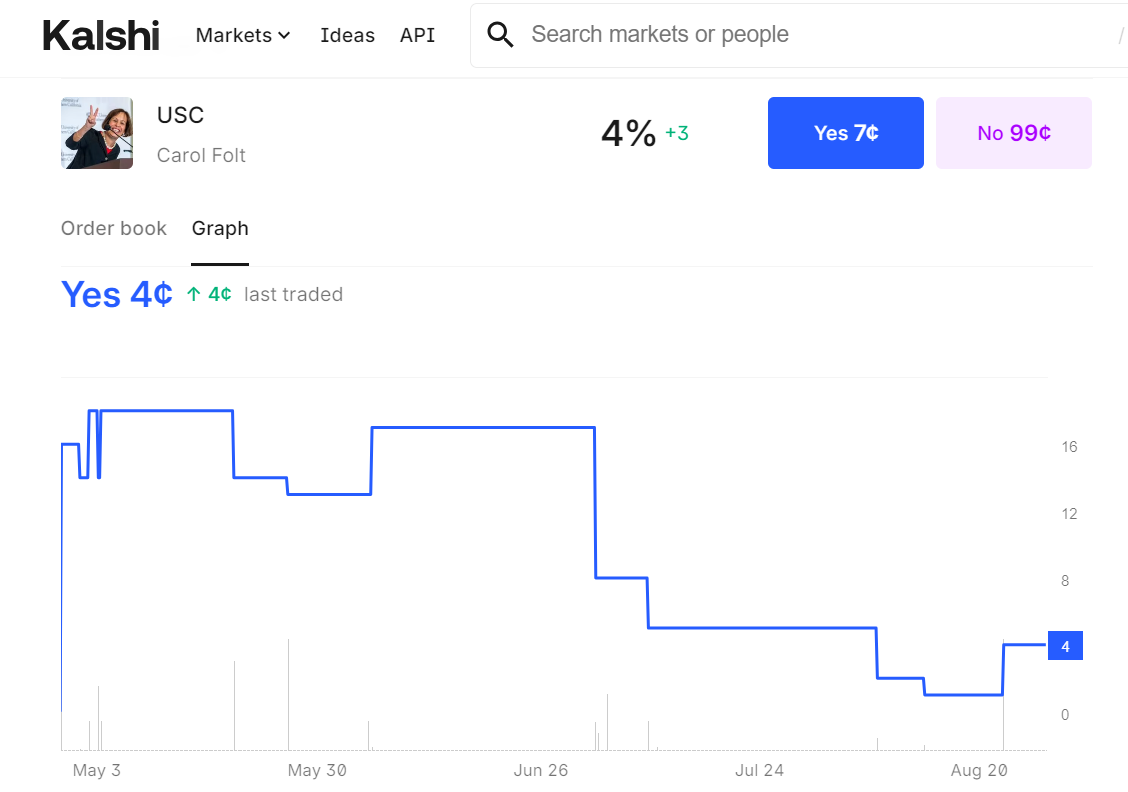
Did you know there is a betting market on resignations of university presidents? Would you pay 4 cents for a $1 contract that USC president Carol Folt will resign by September 1? 

Apparently, some folks are willing to make that bet.

Other university presidents you can bet on:

Northwestern, Indiana, Rutgers, U of North Carolina, and Princeton. (No UCs seem to be on offer.)

Just a little factoid for a slow news day.

More details at https://kalshi.com/markets/unipresidents/university-presidents-ousted.

Wednesday, December 7, 2022

Strike News: Additional Developments - Part 3

We continue noting developments related to the student worker strike below:

From the Sacramento Bee:

A group of striking University of California workers held a sit-in Monday at a downtown Sacramento building, where police officers surrounded them for a few hours before citing them for trespassing... The sit-in coincided with a march on the building, the UC Center Sacramento at 1130 K Street. The center is a teaching, research and public-service site operated by UC Davis that offers an academic program in public policy to students from throughout the UC system... Shortly before 5 p.m. — when the building was scheduled to close for the day — officers gave the workers inside the fourth and final dispersal order. The workers refused to leave. The officers cited and released the 17 workers. Nobody was taken into custody. The workers were each given a date to appear in Sacramento Superior Court...

Full story at https://www.sacbee.com/news/local/article269640286.html.

Also from the Bee:

The University Council-American Federation of Teachers has sent a letter to Gov. Gavin Newsom, urging him “to do everything in your power to immediately resolve the instructional crisis” at the University of California, which is now several weeks into an academic worker strike. The union has accused the UC of failing to bargain in good faith... The letter calls on Newsom to pressure UC President Michael Drake and the UC Board of Regents to pay a living wage to the academic student employees and student researchers, and to impress upon the UC that the state government “is willing to sufficiently reinvest in public higher education to enable all of our schools to pay instructors living wages.”

Full story at https://www.sacbee.com/news/politics-government/capitol-alert/article269625701.html.

Buried in an article in the Daily Cal:

...The UC bargaining team sent the union its first serious proposal late Friday night..., according to [graduate student Roshanak] Gonzalez. She said in an email that the wages offered show “substantial progress” from the last proposal. However, Jonathan Mackris, a picket lead captain, said the offer is still “extremely inadequate.” ...

Full story at https://www.dailycal.org/2022/12/05/uaw-academic-workers-stage-sit-ins-at-california-hall-enter-wheeler-hall.

And somewhat related from Inside Higher Ed:

An associate professor of political science at Indiana University at Bloomington told graduate students that he can’t serve as the department’s job-placement director any longer, as he refuses to participate in the “official department charade.”

“Dear graduate students,” the professor, Abdulkader Sinno, emailed students, “I’m resigning because I don’t want to be complicit in keeping you in a Ph.D. program that doesn’t help your advancement. The department needs graduate students to cheaply teach or assist in teaching its undergraduate students, and for faculty to keep claiming that we have a serious Ph.D. program. I just don’t believe that you should pay for their needs with your livelihood.” ...

Michael McCarthy, a second-year graduate student in the department... posted Sinno’s letter to Twitter... McCarthy has said on social media that one concrete way to help graduate students would be for the university to recognize their union. Graduate assistants at IU-Bloomington went on strike seeking recognition and collective bargaining rights in the spring, but the university refused to accede to these demands. Over the summer, the university offered them contracts that raised minimum stipends from about $18,000 to $22,000...

Full story at https://www.insidehighered.com/news/2022/12/07/faculty-member-issues-dire-warning-grad-students-about-jobs.

===

To hear the text above, click on the link below:

Friday, August 13, 2021

Supreme Court Won't Hear Anti-Vax Mandate Case

From the NY TimesWASHINGTON — The Supreme Court allowed Indiana University on Thursday to require students to be vaccinated against the coronavirus.

Eight students had sued the university, saying the requirement violated their constitutional rights to “bodily integrity, autonomy and medical choice.” But they conceded that exemptions to the requirement — for religious, ethical and medical reasons — “virtually guaranteed” that anyone who sought an exemption would be granted one.

Justice Amy Coney Barrett, who oversees the federal appeals court in question, turned down the students’ request for emergency relief without comment, which is the court’s custom in ruling on emergency applications. She acted on her own, without referring the application to the full court, and she did not ask the university for a response. Both of those moves were indications that the application was not on solid legal footing...

Full story at https://www.nytimes.com/2021/08/12/us/supreme-court-indiana-university-covid-vaccine-mandate.html.

Sunday, December 29, 2019

By George! (Orwell)

Note: There is no indication in the item below from the Washington Post that UCLA is among the universities using the technology described. However, the more university administrators are being held accountable for student behavior, whether for sexual behavior or otherwise, the more the temptation to use whatever tools are around to do it. At about the same time that the Post piece appeared, the NY Times was running a series of articles on use of cellphone data to track movements of individuals ranging from President Trump to ordinary folks. (The Times acquired a large data set of phone info and used it for tracking.)

Colleges are turning students’ phones into surveillance machines, tracking the locations of hundreds of thousands

By Drew Harwell, Dec. 24, 2019, Washington Post

When Syracuse University freshmen walk into professor Jeff Rubin’s Introduction to Information Technologies class, seven small Bluetooth beacons hidden around the Grant Auditorium lecture hall connect with an app on their smartphones and boost their “attendance points.” And when they skip class? The SpotterEDU app sees that, too, logging their absence into a campus database that tracks them over time and can sink their grade. It also alerts Rubin, who later contacts students to ask where they’ve been. His 340-person lecture has never been so full. “They want those points,” he said. “They know I’m watching and acting on it. So, behaviorally, they change.” Short-range phone sensors and campuswide WiFi networks are empowering colleges across the United States to track hundreds of thousands of students more precisely than ever before. Dozens of schools now use such technology to monitor students’ academic performance, analyze their conduct or assess their mental health.

But some professors and education advocates argue that the systems represent a new low in intrusive technology, breaching students’ privacy on a massive scale. The tracking systems, they worry, will infantilize students in the very place where they’re expected to grow into adults, further training them to see surveillance as a normal part of living, whether they like it or not. “We’re adults. Do we really need to be tracked?” said Robby Pfeifer, a sophomore at Virginia Commonwealth University in Richmond, which recently began logging the attendance of students connected to the campus’ WiFi network. “Why is this necessary? How does this benefit us? … And is it just going to keep progressing until we’re micromanaged every second of the day?”

This style of surveillance has become just another fact of life for many Americans. A flood of cameras, sensors and microphones, wired to an online backbone, now can measure people’s activity and whereabouts with striking precision, reducing the mess of everyday living into trend lines that companies promise to help optimize. Americans say in surveys they accept the technology’s encroachment because it often feels like something else: a trade-off of future worries for the immediacy of convenience, comfort and ease. If a tracking system can make students be better, one college adviser said, isn’t that a good thing?

But the perils of increasingly intimate supervision — and the subtle way it can mold how people act — have also led some to worry whether anyone will truly know when all this surveillance has gone too far. “Graduates will be well prepared … to embrace 24/7 government tracking and social credit systems,” one commenter on the Slashdot message board said. “Building technology was a lot more fun before it went all 1984.” Instead of GPS coordinates, the schools rely on networks of Bluetooth transmitters and wireless access points to piece together students’ movements from dorm to desk. One company that uses school WiFi networks to monitor movements says it gathers 6,000 location data points per student every day.

School and company officials call location monitoring a powerful booster for student success: If they know more about where students are going, they argue, they can intervene before problems arise. But some schools go even further, using systems that calculate personalized “risk scores” based on factors such as whether the student is going to the library enough. The dream of some administrators is a university where every student is a model student, adhering to disciplined patterns of behavior that are intimately quantified, surveilled and analyzed. But some educators say this move toward heightened educational vigilance threatens to undermine students’ independence and prevents them from pursuing interests beyond the classroom because they feel they might be watched.

“These administrators have made a justification for surveilling a student population because it serves their interests, in terms of the scholarships that come out of their budget, the reputation of their programs, the statistics for the school,” said Kyle M. L. Jones, an Indiana University assistant professor who researches student privacy. “What’s to say that the institution doesn’t change their eye of surveillance and start focusing on minority populations, or anyone else?” he added. Students “should have all the rights, responsibilities and privileges that an adult has. So why do we treat them so differently?”

Students disagree on whether the campus-tracking systems are a breach of privacy, and some argue they have nothing to hide. But one feeling is almost universally shared, according to interviews with more than a dozen students and faculty members: that the technology is becoming ubiquitous, and that the people being monitored — their peers, and themselves — can’t really do anything about it.

“It embodies a very cynical view of education — that it’s something we need to enforce on students, almost against their will,” said Erin Rose Glass, a digital scholarship librarian at the University of California San Diego. “We’re reinforcing this sense of powerlessness … when we could be asking harder questions, like: Why are we creating institutions where students don’t want to show up?”

SpotterEDU chief Rick Carter, a former college basketball coach, said he founded the app in 2015 as a way to watch over student athletes: Many schools already pay “class checkers” to make sure athletes remain eligible to play. The company now works with nearly 40 schools, he said, including such universities as Auburn, Central Florida, Columbia, Indiana and Missouri, as well as several smaller colleges and a public high school. More than 1.5 million student check-ins have been logged this year nationwide, including in graduate seminars and chapel services.

SpotterEDU uses Bluetooth beacons roughly the size of a deck of cards to signal to a student’s smartphone once a student steps within range. Installers stick them on walls and ceilings — the less visible, Carter said, the better. He declined to allow The Washington Post to photograph beacons in classrooms, saying “currently students do not know what they look like.” School officials give SpotterEDU the students’ full schedules, and the system can email a professor or adviser automatically if a student skips class or walks in more than two minutes late. The app records a full timeline of the students’ presence so advisers can see whether they left early or stepped out for a break.

“Students today have so many distractions,” said Tami Chievous, an associate athletic director at the University of Missouri, where advisers text some freshmen athletes if they don’t show up within five minutes of class. “We have to make sure they’re doing the right thing.” 

The Chicago-based company has experimented with ways to make the surveillance fun, gamifying students’ schedules with colorful Bitmoji or digital multiday streaks. But the real value may be for school officials, who Carter said can split students into groups, such as “students of color” or “out-of-state students,” for further review. When asked why an official would want to segregate out data on students of color, Carter said many colleges already do so, looking for patterns in academic retention and performance, adding that it “can provide important data for retention. Even the first few months of recorded data on class attendance and performance can help predict how likely a group of students is to” stay enrolled.

Students’ attendance and tardiness are scored into a point system that some professors use for grading, Carter said, and schools can use the data to “take action” against truant students, such as grabbing back scholarship funds. The system’s national rollout could be made more complicated by Carter’s history. He agreed earlier this year to stay more than 2,500 feet from the athletic offices of DePaul University, where he was the associate head basketball coach from 2015 to 2017, following an order of protection filed against him and allegations that he had threatened the school’s athletic director and head basketball coach. The order, Carter said, is related to NCAA violations at the program during his time there and has nothing to do with SpotterEDU.

Rubin, the Syracuse professor, said once-thin classes now boast more than 90 percent attendance. But the tracking has not been without its pitfalls: Earlier versions of the app, he said, included a button allowing students to instantly share their exact GPS coordinates, leading some to inadvertently send him their location while out at night. The feature has since been removed.

For even more data, schools can turn to the Austin-based start-up Degree Analytics, which uses WiFi check-ins to track the movements of roughly 200,000 students across 19 state universities, private colleges and other schools. Launched by the data scientist Aaron Benz in 2017, the company says in promotional materials that every student can graduate with “a proper environment and perhaps a few nudges along the way.” Benz tells school administrators that his system can solve “a real lack of understanding about the student experience”: By analyzing campus WiFi data, he said, 98 percent of their students can be measured and analyzed.

But the company also claims to see much more than just attendance. By logging the time a student spends in different parts of the campus, Benz said, his team has found a way to identify signs of personal anguish: A student avoiding the cafeteria might suffer from food insecurity or an eating disorder; a student skipping class might be grievously depressed. The data isn’t conclusive, Benz said, but it can “shine a light on where people can investigate, so students don’t slip through the cracks.” 

To help find these students, he said, his team designed algorithms to look for patterns in a student’s “behavioral state” and automatically flag when their habits change. He calls it scaffolding — a temporary support used to build up a student, removed when they can stand on their own. At a Silicon Valley summit in April, Benz outlined a recent real-life case: that of Student ID 106033, a depressed and “extremely isolated” student he called Sasha whom the system had flagged as “highly at-risk” because she only left her dorm to eat. “At every school, there are lots of Sashas,” he said. “And the bigger you are, the more Sashas that you have.”

A classifier algorithm divides the student body into peer groups — “full-time freshmen,” say, or “commuter students” — and the system then compares each student to “normal” behavior, as defined by their peers. It also generates a “risk score” for students based around factors such as how much time they spent in community centers or at the gym. The students who deviate from those day-to-day campus rhythms are flagged for anomalies, and the company then alerts school officials in case they want to pursue real-world intervention. (In Sasha’s case, Benz said, the university sent an adviser to knock on her door.)

Some administrators love the avalanche of data these kinds of WiFi-based systems bring. “Forget that old ominous line, ‘We know where you live.’ These days, it’s, ‘We know where you are,’ ” Purdue University president Mitch Daniels wrote last year about his school’s location-tracking software. “Isn’t technology wonderful?” But technical experts said they doubted the advertised capabilities of such systems, which are mostly untested and unproven in their abilities to pinpoint student harm. Some students said most of their classmates also didn’t realize how much data was being gathered on their movements. They worried about anyone knowing intimate details of their daily walking patterns and whereabouts.

Several students said they didn’t mind a system designed to keep them honest. But one of them, a freshman athlete at Temple University who asked to speak anonymously to avoid team punishment, said the SpotterEDU app has become a nightmare, marking him absent when he’s sitting in class and marking him late when he’s on time. He said he squandered several of his early lectures trying to convince the app he was present, toggling his settings in desperation as professors needled him to put the phone away. He then had to defend himself to campus staff members, who believed the data more than him.

His teammates, he said, have suffered through their own technical headaches, but they’ve all been told they’ll get in trouble if they delete the app from their phones. “We can face repercussions with our coaches and academic advisers if we don’t show 100 percent attendance,” he said. But “it takes away from my learning because I’m literally freaking out, tapping everything to try to get it to work.” Campus staff, Carter said, can override data errors on a case-by-case basis, and Rubin said a teaching assistant works with students after class to triage glitches and correct points. SpotterEDU’s terms of use say its data is not guaranteed to be “accurate, complete, correct, adequate, useful, timely, reliable or otherwise.”

Carter said he doesn’t like to say the students are being “tracked,” because of its potentially negative connotations; he prefers the term “monitored” instead. “It’s about building that relationship,” he said, so students “know you care about them.” But college leaders have framed the technology in exactly those terms. In emails this year between officials at the University of North Carolina, made available through public-records requests, a senior associate athletic director said SpotterEDU would “improve our ability to track more team members, in more places, more accurately.”

The emails also revealed the challenge for a college attempting to roll out student-tracking systems en masse. In August, near the start of the fall semester, nearly 150 SpotterEDU beacons were installed in a blitz across the UNC campus, from Chapman Hall to the Woollen Gym. The launch was so sudden that some students were alarmed to see an unknown man enter their classroom, stick a small device near their desks, and walk away. The student newspaper, the Daily Tar Heel, reported on “an individual” entering class to install a “tracking device” and filed for school records related to the SpotterEDU contract.

Unclear what was happening, the dean of UNC’s journalism school, Susan King, had someone yank a beacon off the wall after learning of a commotion spreading on Facebook. She told The Post she faulted “stupidity and a lack of communication” for the panic. Carter said the frenzy was due to the school’s need for a quick turnaround and that most installations happen when students aren’t in class. (In an email to UNC staff, Carter later apologized for the mass installation’s “confusion and chaos.”) A UNC spokeswoman declined to make anyone available for an interview, saying only in a statement that the university was evaluating “streamlined attendance tracking” for a “small group of student-athletes.”

But campuswide monitoring appears to be on its way, the emails show. The school is planning to shift to a check-in system designed by a UNC professor, and an IT director said in an email that the school could install beacons across all general-purpose classrooms in time for the spring semester. “Since students have to download the app, that is considered notification and opting-in,” one UNC official wrote. Chris Gilliard, a professor at Macomb Community College in Michigan who testified before Congress last month on privacy and digital rights, said he worries about the expanding reach of “surveillance creep”: If these systems work so well in college, administrators might argue, why not high school or anywhere else?

The systems, he added, are isolating for students who don’t own smartphones, coercive for students who do and unnecessary for professors, who can accomplish the task with the same pop quizzes and random checks they’ve used for decades. “You’re forcing students into a position,” he said: “Be tracked or be left out.”

Some parents, however, wish their children faced even closer supervision. Wes Grandstaff, who said his son, Austin, transformed from a struggling student to college graduate with SpotterEDU’s help, said the added surveillance was worth it: “When you’re a college athlete, they basically own you, so it didn’t matter what he felt: You’re going to get watched and babysat whether you like it or not.” He now says he wishes schools would share the data with parents, too. “I just cut you a $30,000 check,” he said, “and I can’t find out if my kid’s going to class or not?”

Students using Degree Analytics’ WiFi system can opt-out by clicking “no” on a window that asks whether they want to help “support student success, operations and security.” But Benz, the company’s chief, said very few do. That is, until last month at VCU, which recently launched a pilot program to monitor a set of courses required of all freshmen. Students said they were frustrated to first learn of the system in a short email about a “new attendance tool” and were given only two weeks before the opt-out deadline passed. Students quickly scattered the opt-out link across social media, and the independent student newspaper, the Commonwealth Times, sowed doubts about the program’s secrecy and stated mission, writing, “Student success my ass.” The university declined to make an official available for an interview. 

One student who opted out, VCU senior Jacie Dannhardt, said she was furious that the college had launched first-year students into a tracking program none of them had ever heard of. “We’re all still adults. Have a basic respect for our privacy,” she said. “We don’t need hall passes anymore.” The opt-out rate at VCU, Benz said, climbed to roughly half of all eligible students. But he blamed the exodus on misunderstanding and a “reactionary ‘cancel culture’ thing.” “We could have done a much better job communicating, and the great majority of those students who could opt out probably wouldn’t have,” he said.

Joanna Grama, an information-security consultant and higher-education specialist who has advised the Department of Homeland Security on data privacy, said she doubted most students knew they were signing up for long-term monitoring when they clicked to connect to the campus WiFi. She said she worries about school-performance data being used as part of a “cradle-to-grave profile” trailing students as they graduate and pursue their careers. She also questions how all this digital nudging can affect students’ daily lives.

“At what point in time do we start crippling a whole generation of adults, human beings, who have been so tracked and told what to do all the time that they don’t know how to fend for themselves?” she said. “Is that cruel? Or is that kind?”

Source: https://www.washingtonpost.com/technology/2019/12/24/colleges-are-turning-students-phones-into-surveillance-machines-tracking-locations-hundreds-thousands/

Thursday, February 18, 2016

The warning signs continue

Problems keep being reported as various universities around the country investigate charges of sexual harassment or assault. Potential lack of due process and/or other issues of the quality of the investigation.

Inside Higher Ed carries a story today about a student accused of rape by a university who was acquitted in an external trial and ultimately received $245,000 in compensation for lack of due process from the U of Montana.

It also carries a story that Indiana U is revisiting past cases that were handled by a Title IX official who now is accused of sexual assault.

See https://www.insidehighered.com/quicktakes/2016/02/18/montana-will-pay-245k-athlete-accused-rape and https://www.insidehighered.com/quicktakes/2016/02/18/indiana-u-will-review-18-sexual-misconduct-cases. (Both reports have linked to more extensive news accounts.)

Tuesday, October 9, 2012

Parking Revenue: Cash Cow for Higher Ed?

Inside Higher Ed today has a short story about a controversy over a proposed long-term lease of parking facilities at Indiana University to a private operator in exchange for a lump sum payment.  The story links to a longer AP article on the issue which notes that Ohio State U has gone in that direction.

Readers of this blog will know that at the Regents' retreat last month, the Regents discussed a proposal to transfer campus parking services – after a rate increase - to the UC pension fund.  With the higher rate, the parking services would have higher value and would help deal with the unfunded liability in the pension.  Of course, the higher rate would mean a de facto greater employee contribution (for those employees who park) although there would also be “contributions” from non-employee visitors to campuses.  It is important to note that this proposal is a long, long way off from becoming reality, if it ever does.  But the articles referenced above suggest that at least some universities are looking towards parking as a funding remedy.  (The idea seems to have originated with some municipalities that were facing fiscal problems and then spilled over into higher ed circles.)

The Inside Higher Ed story is at

The longer AP story is at

Our audio from last month of the Regents discussing this issue is at
http://uclafacultyassociation.blogspot.com/2012/09/listen-to-parking-to-pension-at-regents.html

And, of course, there is our favorite UCLA hotel which is due to displace a parking structure at absolutely no cost to anyone :).

Anyway, someone is thinking of rounding up the cash cows: