Pages

Showing posts with label UC-Santa Cruz. Show all posts

Saturday, January 31, 2026

Watch the Regents Meetings of Jan. 21, 2026

We are catching up with the Regents meeting of last week. Note that we already covered the termination of a tenured UCLA faculty member.* And we covered the previous day earlier this week.** The Board meeting began with public comments. Topics included UC-Davis women's sports, Teamster bargaining, AFSCME bargaining, grad student support especially international students/use of emergency funds, AI-generated sexual abuse, rent increases by a firm owned by Brookfield Investments, non-cooperation with Trump administration, essential needs of undocumented students, demand to divest from Blackrock and Blackstone, student mental health, Native American remains repatriation, antisemitism, termination of a tenured faculty member, Turning Point and other protests, support for a science center, and NIL for athletes who are injured. There was a brief AFSCME demonstration at one point.

Following public comments, the student president of UCSA discussed various topics including transfer students being below the targeted percentage and concerns about the proposed new faculty disciplinary process. The grad student president raised the issue of sharing of student data with the feds and rent burdens. Thereafter, a new UC-Santa Cruz fundraising campaign was endorsed. Then the above-mentioned faculty termination hearing was held.

At Finance and Capital Strategies, there was a report on the governor's January budget proposal which we have discussed previously. It was noted that the proposal was based on optimistic revenue projections which might not work out. It was also noted that there was potential in the legislature for bonds to finance research and capital projects. Regent Cohen raised the issues of the longer-term fiscal outlook, i.e., beyond the upcoming year. Regent Park asked whether there was a mechanism for developing a new compact with whoever was elected governor in November 2026. (The current compact expires after 2026-27.) 

At Academic and Students Affairs, professional tuition requests were approved for selected programs. Then the proposed faculty discipline process was approved. Coming up with a new process was mandated by the legislature. The new version was approved by the Academic Council. The consultation process with faculty and the Regents was noted. Under the new process, there are specified time limits for the various steps, a systemwide faculty pool so that there will always be faculty available to staff the process, and more precise language and definitions. The new process was approved. Regent Leib requested a report on the process after two years. Then the full board endorsed the various committee endorsements.

As always, we preserve Regents meetings since the Regents have no policy on duration of retention. You can find links to the meeting below:

General site for January 21: https://archive.org/details/1-regents-board-1-21-2026

Full board (initial meeting): https://ia600306.us.archive.org/22/items/1-regents-board-1-21-2026/1-Regents%20Board%201-21-2026.mp4

Finance & Capital Strategies, Academic & Student Affairs, final board session: https://ia800306.us.archive.org/22/items/1-regents-board-1-21-2026/2-Regents%20Finance%20and%20Capital%20Strategies%2C%20Academic%20and%20Student%20Affairs%2C%20Board%201-21-2026.mp4

===

*https://uclafacultyassociation.blogspot.com/2026/01/its-hard-to-keep-lid-on-part-10.html; https://uclafacultyassociation.blogspot.com/2026/01/its-hard-to-keep-lid-on-part-9-and-now.html.

**https://uclafacultyassociation.blogspot.com/2026/01/watch-regents-meetings-of-january-20.html.

Saturday, January 10, 2026

Fast Movers


The San Francisco Chronicle notes there is a small but rising group of undergrads who finish in three years:

"Of the 31,550 students who began studying at a UC campus in 2005, fewer than 1,000 of them, 3%, went on to earn a diploma in three years. By 2021, more than 3,300 students — 6.4% of the 51,934 students who entered UC that year — had their a degree by 2024, just three years after landing on campus."

Full story at https://www.sfchronicle.com/college-admissions/article/uc-three-year-graduation-21251145.php.

Tuesday, January 6, 2026

UCLA ahead in the Wikipedia editing sweepstakes


The Daily Cal calculated the total number of Wikipedia edits - additions and deletions - by campus IP addresses across the UC system. It turns out that since its inception to late 2025, UCLA addresses made over 54,000 edits.

It's not clear whether that's a Good Thing, a Bad Thing, or just a Thing. Below is a chart from the article which can be found at https://data.dailycal.org/2025-12-24-wikiedits


Tuesday, October 28, 2025

Graduate Degrees After Undergraduate

The San Francisco Chronicle provides a listing of the percent of undergrads who go on to get graduate degrees from the various UC campuses. (UC-San Francisco is excluded because it has no undergraduate program.) The chart below highlights Berkeley, but all the other undergraduate campuses are shown:

Source: https://www.sfchronicle.com/projects/2025/uc-graduate-degrees/.

Monday, August 4, 2025

As already noted

Blog readers will have noted yesterday our view that UCLA reaching a Columbia-type monetary settlement with the feds is hard to imagine.* Others agree. From the LA Times:

Mark Yudof, a former UC president who led the system from 2008 to 2013, said he felt the Trump administration was targeting a public university as a way to “make a statement” about the president’s higher education aims going beyond Ivy League institutions. “But this is not Columbia,” Yudof said, referring to the $221-million settlement the New York campus recently reached with the White House to resolve investigations over alleged antisemitism amid its response to pro-Palestinian protests...

“The University of California is much more complex,” said Yudof... “For one, an issue that may affect UCLA is not going to affect UC Merced or UC Riverside. But do you come to an agreement on all campuses? If there is a settlement payment, does it affect all campuses, depending on the cost?” 

George Blumenthal, a former chancellor of UC Santa Cruz, said he “just can’t see UC making the kind of deal that Columbia did or that Harvard contemplates. Committing public funds to Washington to the tune of tens or hundreds of million dollars strikes me as politically untenable in California.” ...

Full story at https://www.latimes.com/california/story/2025-08-02/ucla-doj-trump-settlement-or-lawsuit.

===

*https://uclafacultyassociation.blogspot.com/2025/08/no-relief-from-this-court-what-are.html.

Wednesday, July 30, 2025

Watch the Regents Meeting of July 17, 2025

We are again playing catch-up with the Regents, although we have previously covered July 15 and 16. On the third day of the meetings - July 17 - the agenda began with public comments. Topics covered were tuition, substandard construction on a project at UC-Santa Cruz, layoffs in a student retention program, layoffs at Santa Barbara, layoffs of instructors, loss of federal funding for climate change research and another topics, loss of funding from NSF, opposition to the ban on non-transparent masks at Regents meetings, problems of disabled students, anti-Israel, financial aid, unfair work standards in a Teamsters unit, understaffing in health care, federal science cuts, layoffs at San Diego, leaves of absence for undergraduate students with medical issues, and problems of student-parents.

After public comments, the undergraduate student rep complained about the ban on boycotts by student governments. The graduate student rep complained about rent and dorm conditions at Santa Cruz and a police action. There was then a program about the UC Grand Slam for graduate students. In that program, grad students make a 3-minute presentation on their research projects suitable for a lay audience. Four students from different research areas made presentations in the bio/medical/health care area.

The Regents went into closed session and when the open session resumed, the new chancellor of UC-Santa Barbara - Dennis Assanis - was appointed. The various committees that had met during the prior two days reported and their reports and recommendations were adopted. It was noted that 2025 was the 50th anniversary of CUCSA (for non-union staff) and also the 50th anniversary of the appointment of a student Regents.

There was then a discussion item on replacing the Regents' existing "cohort" tuition plan when it expires with a new program that would begin in 2027-28. Note that although the Regents could just extend the existing plan, a modification was presented which would raise the annual cap on increases, reduce the formula percentage of recycled tuition revenue going to financial aid, and bump up the inflation adjustment by a fixed amount. These changes would raise revenue from tuition and divert some of the increase to things like seismic upgrades.

As might be expected, there was push-back against the proposal, but since at this point the matter was just a discussion item, the push-back was general and alternatives were not presented. Yours truly found the discussion to be disjointed. What was needed, but not presented, was a range of concrete examples of what a student with a particular income, etc., would pay under the old plan and under the new plan under varying assumptions about inflation and various adjustments of the basic formula. 

Regent chair Reilly said the tuition issue would be taken up as an action item at a later meeting, probably in November. Several Regents noted that the political and funding situation in Washington, DC was volatile. Whether there will be more clarity on that front in November is uncertain.

==

As blog readers will know, we retain recordings of Regents meetings indefinitely since the Regents have no policy on duration of retention for their (unlisted) YouTube recordings.

The opening session of the July 17 meeting is at: https://ia601901.us.archive.org/8/items/7-board-8-30-am/7-Board%208_30%20AM.mp4.

The second session of the meeting is at: https://ia801901.us.archive.org/8/items/7-board-8-30-am/8-Board%2011_30%20AM.mp4.

The general website for the recordings is: https://archive.org/details/7-board-8-30-am.

Sunday, May 11, 2025

Only one problem...

The San Francisco Chronicle published the table above of salaries of high-paid undergrad majors. Note that UCLA's business major is among those listed. Only one problem, UCLA does not have an undergrad business major. It does have a "business economics" major within Economics. There hasn't been a straight business major at UCLA since the 1960s.

Yours truly has dim memories of surveys of UCLA undergrads in which many reported "majoring" in business (probably after having taken some undergrad accounting courses) even before the business economics major existed.

Source of table: https://www.sfchronicle.com/california/article/uc-berkeley-computer-science-salary-gap-20307107.php.

Sunday, April 27, 2025

Panunzio Awards for 2024-25


From an email by VC Michael Levine: The 2024-2025 Constantine Panunzio Distinguished Emeriti Award honoring Emeriti Professors in the University of California system has been awarded to Distinguished Research Professor Emerita of Anthropology Diane Gifford-Gonzalez (UC Santa Cruz) and Distinguished Research Professor Emeritus Howard Giles (UC Santa Barbara).

UC Emeriti Professors Gifford-Gonzalez and Giles are the fifty-fourth and fifty-fifth recipients of the Constantine Panunzio Award. Both awardees have especially long and notable records of research, teaching, and service to the University of California, their disciplines, and their communities. The late Dr. Panunzio, a Professor of Sociology at UCLA for many years, has been described as the architect of the UC Retirement System and was particularly active in improving pensions and stipends for his fellow Emeriti. The award bearing his name was established in 1983 and includes a $5,000 prize. The Panunzio Award exemplifies the tremendous contributions of Emeriti to the continued excellence of the UC System.

Diane Gifford-Gonzalez, UC Santa Cruz, Distinguished Research Professor Emerita of Anthropology retired in 2015. Professor Emerita Gifford-Gonzalez is internationally recognized as one the foremost authorities in zooarchaeology and continues to provide intellectual and committed leadership to her discipline. Her expertise intersects archaeology, zooarchaeology, gender, the history of pastoralism in sub-Saharan Africa, and the Indigenous communities in California’s Monterey Bay area. Her research has led to real-world impacts including the successful disposition of ancestral remains for the Amah Mutsun Tribal Band of Coastanoan/Ohlone Indians, and an ongoing eco-archaeological project to examine diverse lines of evidence for Indigenous landscape and seascape stewardship practices over 7000 years on the Central California Coast. Having been a founding cohort of zooarchaeology, the study of human-animal interactions, in 2018 she published the leading textbook – An Introduction to Zooarchaeology. Her scholarship continues with publications in leading peer-reviewed journals; she has served as the keynote speaker at three major international conferences, and has given Distinguished Lectures, including at the Institute for Human History at the Max Planck Institute in Jena (2017). Professor Emerita Gifford-Gonzalez has received significant recognition for her research with honors, and among them are election to the National Academy of Sciences (2024), appointed as a Fellow of the American Association for the Advancement of Science, Anthropology Section (2023), is the recipient of the Distinguished Social Sciences Emeriti Faculty Award from UCSC (2020), as well as being a Fellow, Centre for Advanced Study, Norwegian Academy of Sciences and Letters, Oslo (2015-2016). Service to her campus continues with supervision of doctoral students, service on UCSC senate committees, the Nature Reserves Advisory Committee, and the Emeriti Association (2023-2024).

====

Howard Giles, UC Santa Barbara, Distinguished Research Professor Emeritus of Communication retired in 2017. Since becoming an Emeritus Professor, Howard Giles has retained his influence in the multi-disciplinary fields of social psychology of language and communication; intergenerational communication and aging; and intergroup communication more broadly. He is widely considered the leading scholar in these disciplines and is viewed as the “Architect of Communication Scholarship.” His research productivity since retirement focuses on three domains: aging, Communication Accommodation Theory (CAT) which he founded, and police-community relations. Works include a co-authored book, eight special journal issues, 47 coauthored peer-reviewed articles, and numerous other publications and significant editorial work, in addition to national and international paper presentations. Recognition has been bestowed upon him with two professional associations naming awards in his honor, the “Inaugural Giles Mentorship Award” from the International Association of Language & Social Psychology and the “Howard Giles Top Student Paper Award” from the International Communication Association. His contributions include continued service to his campus, teaching, and mentorship. Since 2021 he has been an affiliate of UCSB’s Center for Aging & Longevity Studies. Post retirement he became a fellow in a number of societies, and in 2023 he was invited to become a Fellow of the Royal Society of Medicine. In addition to his dedication to students and UCSB, his commitment to campus-community relationships is reflected in his service as the Director of the Volunteer in Policing Corp for the Santa Barbara Police Department (SBPD), earning him a nomination as the SBPD Civilian Supervisor of the Year Award. His involvement in this area of police-community relations has also resulted in collaborations with the police department, including a handbook on policing and communication as well as an intervention program called VOICES that promotes dialog between the police and marginalized members of the community.

Saturday, April 26, 2025

Missing Persons?

The statement below was released this past week by the American Association of Colleges and Universities. Lots of signatories from university and college leaders, but none from UC with the exception of Chancellor Kim Wilcox of UC-Riverside were on the original. UCLA Chancellor Frenk added his name subsequently as did the chancellors of Merced, Berkeley, Santa Cruz, and San Diego. Still later, UC President Drake and the remaining chancellors signed on.

A Call for Constructive Engagement

As leaders of America’s colleges, universities, and scholarly societies, we speak with one voice against the unprecedented government overreach and political interference now endangering American higher education. We are open to constructive reform and do not oppose legitimate government oversight. However, we must oppose undue government intrusion in the lives of those who learn, live, and work on our campuses. We will always seek effective and fair financial practices, but we must reject the coercive use of public research funding.

America’s system of higher learning is as varied as the goals and dreams of the students it serves. It includes research universities and community colleges; comprehensive universities and liberal arts colleges; public institutions and private ones; freestanding and multi-site campuses. Some institutions are designed for all students, and others are dedicated to serving particular groups. Yet, American institutions of higher learning have in common the essential freedom to determine, on academic grounds, whom to admit and what is taught, how, and by whom. Our colleges and universities share a commitment to serve as centers of open inquiry where, in their pursuit of truth, faculty, students, and staff are free to exchange ideas and opinions across a full range of viewpoints without fear of retribution, censorship, or deportation.

Because of these freedoms, American institutions of higher learning are essential to American prosperity and serve as productive partners with government in promoting the common good. Colleges and universities are engines of opportunity and mobility, anchor institutions that contribute to economic and cultural vitality regionally and in our local communities. They foster creativity and innovation, provide human resources to meet the fast-changing demands of our dynamic workforce, and are themselves major employers. They nurture the scholarly pursuits that ensure America’s leadership in research, and many provide healthcare and other essential services. Most fundamentally, America’s colleges and universities prepare an educated citizenry to sustain our democracy.

The price of abridging the defining freedoms of American higher education will be paid by our students and our society. On behalf of our current and future students, and all who work at and benefit from our institutions, we call for constructive engagement that improves our institutions and serves our republic.

Signed, [original signatures only]

Jonathan Alger, President, American University

Barbara K. Altmann, President, Franklin & Marshall College

Suzanne Ames, President, Peninsula College

Carmen Twillie Ambar, President, Oberlin College

Denise A. Battles, President, SUNY Geneseo

Ian Baucom, Incoming President, Middlebury College

Allan Belton, President, Pacific Lutheran University

Hubert Benitez, President, Saint Peter's University

Joanne Berger-Sweeney, President, Trinity College (CT)

Michael A. Bernstein, President, The College of New Jersey

Audrey Bilger, President, Reed College

Erik J. Bitterbaum, President, SUNY Cortland

Sarah Bolton, President, Whitman College

Mary H. Bonderoff, President, SUNY Delhi

Eric Boynton, President, Beloit College

Elizabeth H. Bradley, President, Vassar College

Brian Bruess, President, College of Saint Benedict and Saint John's University

Adam Bush, President, College Unbound

Alison Byerly, President, Carleton College

Wendy Cadge, President and Professor of Sociology, Bryn Mawr College

Nancy Cantor, President, Hunter College CUNY

Alberto Jose Cardelle, President, SUNY Oneonta

Brian W. Casey, President, Colgate University

Ana Mari Cauce, Professor and President, University of Washington

Andrea Chapdelaine, President, Connecticut College

Thom D. Chesney, President, Southwestern College (NM)

Bryan F. Coker, President, Maryville College

Ronald B. Cole, President, Allegheny College

Soraya Coley, President, Cal Poly Pomona

Jennifer Collins, President, Rhodes College

John Comerford, President, Otterbein University

Marc C. Conner, President, Skidmore College

Joy Connolly, President, American Council of Learned Societies

La Jerne Terry Cornish, President, Ithaca College

Grant Cornwell, President, Rollins College

Isiaah Crawford, President, University of Puget Sound

Gregory G. Dell'Omo, President, Rider University

Kent Devereaux, President, Goucher College

Jim Dlugos, Interim President, Landmark College

Bethami Dobkin, President, Westminster University

Harry Dumay, President, Elms College

Christopher L. Eisgruber, President, Princeton University

Michael A. Elliott, President, Amherst College

Alexander Enyedi, President, SUNY Plattsburgh

Jane Fernandes, President, Antioch College

Roland Fernandes, General Secretary, General Board of Higher Education and Ministry

Damian J. Fernandez, President, Warren Wilson College

David Fithian, President, Clark University

Lisa C. Freeman, President, Northern Illinois University

Robert Gaines, Acting President, Pomona College

James Gandre, President, Manhattan School of Music

Alan M. Garber, President, Harvard University

Jay D. Gatrell, President, Eastern Illinois University

Michael H. Gavin, President, Delta College

Mark D. Gearan, President, Hobart and William Smith Colleges

Melissa Gilliam, President, Boston University

Lane A. Glenn, President, Northern Essex Community College

Jorge G. Gonzalez, President, Kalamazoo College

Jonathan D. Green, President, Susquehanna University

David A. Greene, President, Colby College

William R. Groves, Chancellor, Antioch University

Jeremy Haefner, Chancellor, University of Denver

Yoshiko Harden, President, Renton Technical College

Anne F. Harris, President, Grinnell College

James T. Harris, President, University of San Diego

Marjorie Hass, President, Council of Independent Colleges

Richard J. Helldobler, President, William Paterson University

Wendy Hensel, President, University of Hawaii

James Herbert, President, University of New England

Doug Hicks, President, Davidson College

Mary Dana Hinton, President, Hollins University

Danielle R. Holley, President, Mount Holyoke College

Jonathan Holloway, President, Rutgers University

Robin Holmes-Sullivan, President, Lewis & Clark College

Robert H. Huntington, President, Heidelberg University

Nicole Hurd, President, Lafayette College

Wolde-Ab Isaac, Chancellor, Riverside Community College District

Karim Ismaili, President, Eastern Connecticut State University

J. Larry Jameson, President, University of Pennsylvania

Garry W. Jenkins, President, Bates College

Paula A. Johnson, President, Wellesley College

John E. Jones III, President, Dickinson College

Katrina Bell Jordan, President, Northeastern Illinois University

Cristle Collins Judd, President, Sarah Lawrence College

David L. Kaufman, President, Capital University

Colleen Perry Keith, President, Goldey-Beacom College

Marisa Kelly, President, Suffolk University

Julie Johnson Kidd, President, Endeavor Foundation

Jonathan Koppell, President, Montclair State University

Sally Kornbluth, President, Massachusetts Institute of Technology

Julie Kornfeld, President, Kenyon College

Michael I. Kotlikoff, President, Cornell University

Paula Krebs, Executive Director, Modern Language Association

Sunil Kumar, President, Tufts University

Bobbie Laur, President, Campus Compact

Frederick M. Lawrence, Secretary and CEO, Phi Beta Kappa Society

Linda M. LeMura, President, Le Moyne College

Hilary L. Link, President, Drew University

Patricia A. Lynott, President, Rockford University

Heidi Macpherson, President, SUNY Brockport

John Maduko, President, Connecticut State Community College

Lynn Mahoney, President, San Francisco State University

Daniel Mahony, President, Southern Illinois University

Maud S. Mandel, President, Williams College

Christine Mangino, President, Queensborough Community College

Amy Marcus-Newhall, President, Scripps College

Felix V. Matos-Rodriguez, Chancellor, City University of New York (CUNY)

Anne E. McCall, President, The College of Wooster

Richard L. McCormick, Interim President, Stony Brook University

Michael McDonald, President, Great Lakes Colleges Association

James McGrath, President and Dean, Cooley Law School

Patricia McGuire, President, Trinity Washington University

Maurie McInnis, President, Yale University

Elizabeth M. Meade, President, Cedar Crest College

Scott D. Miller, President, Virginia Wesleyan University

Jennifer Mnookin, Chancellor, University of Wisconsin–Madison

Robert Mohrbacher, President, Centralia College

Chris Moody, Executive Director, ACPA-College Student Educators International

Tomas Morales, President, California State University San Bernardino

Milton Moreland, President, Centre College

Kathryn Morris, President, St. Lawrence University

Ross Mugler, Board Chair and Acting President and CEO, Association of Governing Boards of Universities and Colleges

Krista L. Newkirk, President, University of Redlands

Stefanie D. Niles, President, Cottey College

Claire Oliveros, President, Riverside City College

Robyn Parker, Interim President, Saybrook University

Lynn Pasquerella, President, American Association of Colleges and Universities

Laurie L. Patton, President, American Academy of Arts and Sciences

Beth Paul, President, Nazareth University

Christina Paxson, President, Brown University

Rob Pearigen, Vice-Chancellor and President, University of the South

Deidra Peaslee, President, Saint Paul College

Eduardo M. Peñalver, President, Seattle University

Ora Pescovitz, President, Oakland University

Darryll J. Pines, President, University of Maryland

Nicola Pitchford, President, Dominican University of California

Kevin Pollock, President, Central Carolina Technical College

Susan Poser, President, Hofstra University

Paul C. Pribbenow, President, Augsburg University

Vincent Price, President, Duke University

Robert Quinn, Executive Director, Scholars at Risk Network

Wendy E. Raymond, President, Haverford College

Christopher M. Reber, President, Hudson County Community College

Andrew Rehfeld, President, Hebrew Union College

Suzanne M. Rivera, President, Macalester College

Michael S. Roth, President, Wesleyan University

James Ryan, President, University of Virginia

Vincent Rougeau, President, College of the Holy Cross

Kurt L. Schmoke, President, University of Baltimore

Carol Geary Schneider, Acting Executive Director, Civic Learning and Democracy Engagement Coalition

Sean M. Scott, President and Dean, California Western School of Law

Zaldwaynaka Scott, President, Chicago State University

Philip J. Sisson, President, Middlesex Community College (MA)

Suzanne Smith, President, SUNY Potsdam

Valerie Smith, President, Swarthmore College

Paul Sniegowski, President, Earlham College

Barbara R. Snyder, President, Association of American Universities

Stephen Snyder, Interim President, Middlebury College

Rachel Solemsaas, President, North Seattle College

Weymouth Spence, President, Washington Adventist University

Terri Standish-Kuon, President and CEO, Independent Colleges of Washington

G. Gabrielle Starr, President, Pomona College

Karen A. Stout, President, Achieving the Dream

Tom Stritikus, President, Occidental College

Julie Sullivan, President, Santa Clara University

Aondover Tarhule, President, Illinois State University

Glena Temple, President, Dominican University

Steven J. Tepper. President, Hamilton College

Kellye Y. Testy, CEO, Association of American Law Schools

Tania Tetlow, President, Fordham University

Strom C. Thacker, President, Pitzer College

Scott L. Thomas, President, Sterling College

Stephen Thorsett, President, Willamette University

Joel Towers, President, The New School

Deborah Trautman, President and CEO, American Association of Colleges of Nursing

Satish K. Tripathi, President, University at Buffalo, SUNY

James Troha, President, Juniata College

Kyaw Moe Tun, President, Parami University

Brad Tyndall, President, Central Wyoming College

LaTanya Tyson, President, Carolina Christian College

Matthew P. vandenBerg, President, Ohio Wesleyan University

James Vander Hooven, President, Mount Wachusett Community College

Laura R. Walker, President, Bennington College

Yolanda Watson Spiva, President, Complete College America

Phil Weilerstein, President, VentureWell

Michaele Whelan, President, Wheaton College

Manya C. Whitaker, Interim President, Colorado College

Julie A. Manley White, Chancellor and CEO, Pierce College

Kim A. Wilcox, Chancellor, University of California, Riverside

Sarah Willie-LeBreton, President, Smith College

Safa R. Zaki, President, Bowdoin College

==

Source: https://www.aacu.org/newsroom/a-call-for-constructive-engagement.

Wednesday, April 2, 2025

Low Applications Campuses Grow the Most

The San Francisco Chronicle provided the table above. It shows:

1) UCLA received the most applications of all the undergraduate campuses.

2) The low application campuses (Merced and Riverside) experienced the largest increases in applications, whether gauged from last year or pre-pandemic 2019. (Merced provided free applications to drive up applications this year.)

3) All campuses have significantly increased applications since 2019. But growth over last year at the high-application campuses stalled relative to last year.

Reminder: Applications are not the same as final enrollments. Enrollments are determined by the acceptance rate of the campus and within it, the acceptance rate of applicants.

Source: https://www.sfchronicle.com/college-admissions/article/uc-applications-20238586.php.
 

Saturday, February 22, 2025

Lost Funding


The NY Times provides a search option that allows information on how much NIH grant recipients would lose in fiscal year 2024 under a cap of 15% on indirect costs. Yours truly focused on UC in the table below. As can be seen, the total loss for all institutions in California is almost $800 million, about half of which falls on UC:

Loss of NIH funding in fiscal 2024 if indirect costs limited to 15%.

====================================================
University of California, San Francisco   -$121 mil.
University of California, San Diego       -$102 mil.
University of California, Los Angeles      -$65 mil.
University of California, Davis            -$49 mil.
University of California, Irvine           -$41 mil.
University of California, Berkeley         -$25 mil.
University of California, Santa Cruz        -$7 mil.
University of California, Riverside         -$7 mil.
University of California, Santa Barbara     -$3 mil.
UC Lawrence Berkeley Lab                    -$6 mil.
University of California, Merced            -$1 mil.
========================
  Total UC                                -$427 mil.
========================
Total State of California                 -$796 mil.
========================
Note: UC as percent of California               54%
====================================================

Thursday, January 16, 2025

Something's Happening - Part 2 (Where's UCLA?)

We noted on Monday that an unusual meeting of the systemwide Academic Senate had been called for this coming Friday by petition.* The meeting was called to discuss faculty unhappiness with regard to three issues:

  1. The lack of consultation for implementing the Information Security Investment Plan and the potential negative effects of the plan on faculty’s research, teaching, and merits and promotions.
  2. UCOP’s differential treatment of faculty and administrators regarding compensation and cost-of-living adjustments.
  3. The University of California’s continued decrease in percent contribution to medical plans.

When you look at the petition (attached to the meeting agenda), you find the names and campuses of those who called for the special session.** Represented among the petitioners are Davis, Irvine, Berkeley, San Francisco, Santa Barbara, and Riverside. Merced, Santa Cruz, and UCLA are not represented. So, that does mean that at UCLA in particular, nobody was particularly concerned with at least one of the three issues? Is UCLA somehow out of the loop? Just asking...

It might be noted that yours truly became aware of this matter after being forwarded an announcement from UC-Irvine's Senate, not from the UCLA Senate. 

NOTE: I notified the UCLA Senate about the upcoming systemwide meeting on Jan. 13.

==

*https://uclafacultyassociation.blogspot.com/2025/01/somethings-happening.html.

**https://senate.universityofcalifornia.edu/_files/assembly/assembly-agenda-special-meeeting-1-17-25.pdf.

Friday, January 3, 2025

Multicampus Research

The University of California Office of the President has awarded $15.5 million in grants to teams of UC researchers on the cutting edge of medicine, artificial intelligence, agriculture and climate justice.

Awarded every two years through a highly competitive process, the Multicampus Research Program Initiative (MRPI) draws on the world-class resources and capabilities of UC’s $7 billion research enterprise, uniting teams of cross-disciplinary experts from at least three UC campuses to pursue ambitious questions with immediate applications.

“The MRPI program funds discoveries that are made possible only by the convergence of disciplines to improve the lives of Californians and draws world-class student, faculty and staff talent to our university and our state,” said UC Vice President of Research and Innovation Theresa Maldonado. “UC programs like this help keep California at the forefront of breakthrough research, technological innovation and equitable opportunities to thrive.”

Since 2009, the university has made 125 MRPI grants totaling $156.6 million and involving 739 UC faculty members. This year, 153 teams applied for grants. These are the 14 winners.

--

Four teams will advance health and medical science, studying autism, active matter, sepsis and maternal health.

Scientists from UC Berkeley, UC Santa Cruz and UC San Francisco will use cell samples from patients with autism spectrum disorder to grow self-organizing, 3D clumps of neurological tissue in a lab. These “brain organoids” are an efficient, less invasive way to narrow the search for the molecular, cellular, and developmental factors that lead to autism spectrum disorder, an untreatable condition that affects 1 in 22 California kids.

Organoids are one example of active matter, an emerging paradigm at the intersection of physics and biology that studies instances of individual entities organizing themselves into coherent structures. Scientists at UC Merced, UC Santa Barbara and UC San Diego will use MRPI funding to establish the UC Active Matter Hub, seeding global leadership in a field with potential to reshape adaptive technologies and wearable devices.

A team from UC San Diego, UC Irvine and UCLA aim to scale up a proven method for detecting sepsis, an infection so dangerous that it kills 16 percent of people who contract it. UC scientists developed a life-saving algorithm that scans real-time data from electronic health records, assessing over 150 variables to detect early signs of infection so doctors can begin treatment. By rolling out this algorithm to more emergency departments across California, researchers aim to save 8,000 lives annually. 

A lack of maternal health data is making it harder to fight the nation’s escalating rates of illness and death among pregnant and postpartum patients. Experts from UC San Francisco, UC Irvine, UCLA and UC San Diego are joining forces to create a central clinical data repository for every pregnancy and birth across four major hospitals, which they’ll use to study variations in care within the system and the impact on maternal and neonatal health outcomes.

--

Three teams will make advances in agriculture.

Experts from UC’s five Agricultural Experiment Stations will convene to study barriers and opportunities for California farms to adopt practices and principles of agroecology. The team from UC Davis, UC Berkeley, UC Santa Cruz, UC Merced, UC Riverside and UC Agriculture and Natural Resources aims to boost the agriculture industry’s climate resilience, biodiversity, equity and economic viability.

Researchers from UC Riverside, UC Davis and UC Santa Barbara will develop and test new ways to decontaminate wastewater, destroying or filtering out toxic “forever” chemicals and disease-causing microbes so the water can be used to irrigate crops. That should ease water scarcity, a major constraint for California farmers that will only get worse as the climate warms.

Scientists at UC San Diego, UC Berkeley and UC Riverside aim to climate-proof agriculture by redesigning dirt. They’ll use the grant to develop 3D-printable hydrogels to use in place of soil in hydroponic or vertical farms. This high-tech dirt substitute will be infused with microbes that will help crops resist stress, grow faster and use less water.

--

Four teams are devising solutions to challenges facing Californians on the front lines of climate change.

Researchers at UC Santa Barbara, UC Davis, UC Irvine and UC San Francisco aim to better understand how hotter and more frequent heat waves are affecting California’s 6 million public school students. Working with students, teachers, administrators and families at nine schools across the state, they’ll gather data on heat stress and pilot school-level changes that communities can use to protect themselves.

UC scholars have long engaged in climate justice partnerships across California. A team from UC Irvine, UC Santa Cruz, UC Santa Barbara and UCLA will analyze existing youth climate engagement programs at each campus and develop common principles to replicate these programs’ impacts in California and around the world.

As record numbers of people seek asylum in the U.S., climate change multiplies the forces that cause people to leave their homes. Immigration scholars from UC San Diego, UC Berkeley, UC Irvine and UC Santa Barbara are teaming up with asylum organizations in the U.S. and Mexico to better understand how federal policies and practices affect migrants, particularly kids and families.

Led by UC Santa Cruz, eight campuses aim to use arts and culture to spur climate action. The UC Climate Action Arts Network will build on a previous MRPI grant to fund artists and communities across California to design creative approaches to grappling with the stark realities of climate change and injustice.

--

Four teams are breaking new ground in AI and basic research.

California is America’s most linguistically diverse state: nearly half of us speak a language besides English. And yet language-based artificial intelligence like ChatGPT has overwhelmingly been trained on English — which could become a problem as AI’s influence expands into government, health care and culture. A six-campus team led by UC Santa Cruz will study whether and how prevailing AI technologies leave Californians behind and propose new ways to develop large language models that work equally well, no matter the user’s mother tongue.

Scholars from UC Berkeley, UC San Diego and UC Davis are taking on what they call “one of the grand challenges of algorithms research.” The team aims to speed up one of modern computing’s foundational processes, matrix multiplication. Streamlining matrix multiplication could break through a bottleneck that’s limiting advances in machine learning, data mining, physics simulations, ushering in the next generation of computational discovery.

Physicists use photons, or light particles, to investigate the fundamental laws of nature, gleaning insights on everything from gravitational waves to supernovae. But the photon-emitting X-ray devices used for research are big, expensive, finicky and hard to control. A team from UCLA, UC Irvine and UC San Diego aims to bring emerging quantum X-ray technology from theory to reality. By demonstrating quantum X-ray emission, they’ll open the door to advances in basic sciences and commercial and medical applications.

==

Source: https://www.universityofcalifornia.edu/news/uc-awards-155m-research-grants-tackle-big-questions-health-ai-agriculture-and-climate-justice.

Application information for new proposals: https://www.ucop.edu/research-initiatives/programs/mrpi/files/mrpi-rfp.pdf.

Friday, December 27, 2024

The UC Deal With OCR - Part 2 (to do list)

We earlier provided the basic documents that were involved in OCR's agreement with UC and UCLA to resolve civil rights complaints that stemmed from the protests and encampments.

Below is a summary of what UC is obligated to do from the Bruin:

...UC agreed to several terms with the OCR to rectify its Title VI compliance issues, according to the resolution agreement. The two parties first agreed that the OCR would review and approve any revisions to the University’s antidiscrimination policies and “guidelines that it uses to address its compliance with Title VI.”

The agreement also requires the UC to train its employees who investigate discrimination complaints for impartiality and effectiveness in response. Public safety officers who respond to or investigate discrimination incidents must also receive training on nondiscrimination requirements under Title VI, according to the agreement.

The University must provide documentation of this training to the OCR by Dec. 31, 2025, according to the agreement.

By Sept. 30, 2025, the OCR must also receive a file of the University’s – or each individual campus’ – response to discrimination complaints at UCSB, UCSC, UCSD, UC Davis and UCLA during the 2024-2025 academic year, according to the agreement.

These reports will include 23 data points at a minimum, including the supportive measures offered to the complainant, names of the individuals who engaged in discrimination, outcomes of the investigations, corrective actions taken and steps the University or individual campus took to eliminate a potential recurrence of the event.

The University must also develop voluntary “climate surveys” that include questions regarding a student’s knowledge of discriminatory acts against students or employees on the basis of shared ancestry or national origin, according to the agreement. The UC has also agreed to provide a report to the OCR regarding proposed actions based on the survey and, within 60 days of the OCR’s approval, must provide documentation of implementation of these actions.

“The University will analyze the results of the climate survey(s) within 90 calendar days of its completion to identify appropriate action(s) that the University and/or the individual University campuses will take to improve the climate at the campus and the University more broadly with respect to nondiscrimination based on national origin, including shared Jewish, Palestinian, Muslim, and/or Arab ancestry,” the agreement said.

By Jan. 17, UC President Michael Drake must issue a statement to students and employees stating the University’s intolerance for discrimination, commitment to addressing such issues and ways to report harassment, according to the agreement. The UCLA chancellor must also send a campuswide message by the same deadline with a telephone number and email address to report discriminatory incidents, the agreement said.

UCLA must “promptly investigate” if students were blocked from accessing campus based on their Jewish or Israeli heritage, according to the agreement, as well as if faculty held classes or office hours within the encampment...

The OCR said in the agreement that it would provide the UC with a notice and 60 days to fix any potential violations of the contract that may occur. If the UC does not comply within 60 days, the Department of Education could initiate enforcement proceedings or refer the case to the U.S. Department of Justice.

Friday, December 20, 2024

The UC Deal With OCR

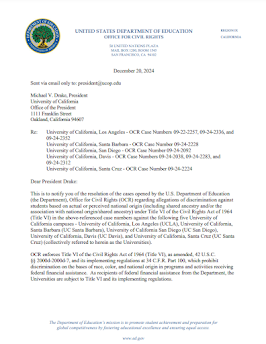
The Office of Civil Rights (within the US Dept. of Education) has reached an agreement with UC to resolve the various complaints arising from last academic year's protests:

Press Release  US Dept. of Education

Office for Civil Rights Announces Resolution of Complaints Alleging Shared Ancestry Discrimination by Five Campuses in University of California System

Agreement resolves nine complaints filed with OCR against five University of California campuses in Los Angeles (UCLA), Santa Barbara (UCSB), San Diego (UCSD), Davis (UCD) and Santa Cruz (UCSC)

December 20, 2024

The U.S. Department of Education’s Office for Civil Rights (OCR) today announced that the University of California has entered into a resolution agreement to ensure its compliance with Title VI of the of the Civil Rights Act of 1964 (Title VI) when responding to allegations of harassment or other discrimination based on national origin, including shared Jewish, Israeli, Muslim, Palestinian, and Arab ancestry. 

The agreement resolves nine complaints filed with OCR against five University of California (UC) campuses in Los Angeles (UCLA), Santa Barbara (UCSB), San Diego (UCSD), Davis (UCD), and Santa Cruz (UCSC). The complaints alleged that these universities failed to respond promptly or effectively to harassment of their students based on their actual or perceived national origin (including shared Jewish, Israeli, Muslim, Palestinian, and Arab ancestry) and that some of these universities subjected these students to different treatment with respect to their access to campus or university programs. 

OCR’s investigations included interviewing students and university employees and reviewing university policies and procedures, information related to reports and complaints made to university campuses, and publicly available information such as videos of alleged harassing events on campus in 2023 and 2024. Additionally, OCR reviewed 2024 university taskforce reports and court filings about the alleged harassment at UCLA. Before OCR completed its investigations, the University of California expressed an interest in resolving them through an agreement under Section 302 of OCR’s case processing manual, and OCR determined that resolving its compliance concerns to date through an agreement was appropriate. 

These concerns include that university campuses appear to have failed to respond promptly or effectively to a possible hostile environment based on national origin/shared ancestry when: (1) the alleged harassing conduct or protests involved First Amendment-protected speech and the universities appear not to have evaluated if the conduct never the less created a hostile environment based on shared ancestry for affected students; or (2) some of the universities’ responses to alleged shared ancestry harassment may have failed to remedy the effects of a potential or apparent hostile environment and prevent a recurrence of the alleged harassment. 

With regard to UCLA and its law school, OCR’s compliance concerns stemmed in part from the university’s receipt of more than 150 reports about protests and rallies in October and November 2023, as well as complaints related to an encampment on campus in spring 2024. These and other reports included: 

Reports of rally chants such as, “death to Israel,” “[t]here is no peace until they’re dead,” “intifada now,” and “there is only one solution.” A separate video reviewed by OCR depicted a group that included students beating an effigy of Israel’s Prime Minister and shouting “beat that f*cking Jew” on the campus. 

Muslim, Palestinian, and/or pro-Palestinian students experienced unwanted filming, doxing, and being followed both on and near UCLA’s campus by other students and members of the public. 

Reports of checkpoints at the spring 2024 encampment that allegedly denied entry to Jewish students who refused to “denounce their Zionism.” 

UCLA, through its campus police, allegedly failed to protect Palestinian, Arab, and/or pro-Palestinian student protestors while they were violently attacked, injured, and intimidated by counter-protestors, including third parties. 

Of particular concern were reports of violence against students of Jewish and Israeli ancestry by protesters at the encampment and of a violent assault by counter-protestors on pro-Palestinian protesters at the encampment on April 30, 2024, and the subsequent law enforcement response, which the UCLA Chancellor described as one in which students “feared for their safety.” In addition, OCR has a concern that the encampment at UCLA in spring 2024 may have subjected students to different treatment based on their national origin/shared Jewish ancestry, when their access to parts of the campus or UCLA programs was limited. OCR identified a similar concern about possible disparate treatment with respect to Jewish students’ access to a multicultural center at UC Santa Barbara. 

Similarly, the evidence to date showed that UC Santa Barbara, UC Davis, UC San Diego, and UC Santa Cruz all had widely reported incidents of alleged harassment against students based on their national origin, including shared ancestry, indicating that these universities also had notice of a potential hostile environment for their students of Jewish, Israeli, Palestinian, Muslim, and/or Arab ancestry. For example, UC Santa Barbara received notice of antisemitic vandalism at a dorm room and signs posted at a student center that targeted some named Jewish students and stated that Zionists were not welcome. UC San Diego and UC Davis also received reports and complaints about students witnessing or experiencing antisemitic comments or actions by students and professors at protests, online, or in campus departments. Chancellors at various UC campuses made statements to their communities acknowledging hate speech, antisemitic and anti-Muslim discrimination, and/or other harms that students on their respective campuses had experienced. 

To resolve the Title VI compliance concerns that OCR identified to date, the University of California has committed to implement actions, including: 

Reviewing complaints and reports of harassment and other discrimination based on shared ancestry in academic years (AY) 2023-2024 and 2024-2025 to determine if the alleged conduct created a hostile environment and if further action is needed to provide an equitable resolution of each reported incident. 

Reporting to OCR the universities’ responses to reports of harassment and other discrimination based on shared ancestry in the 2023-2024 and 2024-2025 school years. 

Obtaining OCR approval for any revisions to university policies and procedures to ensure that they address Title VI’s prohibition on discrimination based on race, color, and national origin, including actual or perceived shared ancestry or ethnic characteristics. 

Training university employees and public safety and campus police officers responsible for investigating reports and complaints of discrimination about the university’s policies, procedures, and obligations under Title VI to respond to shared ancestry discrimination. 

Administering a climate assessment for university students and employees to evaluate the extent to which they are subjected to or witness harassment and other discrimination based on race, color, and national origin, including actual or perceived shared ancestry or ethnic characteristics, and know how to report such discrimination. And,

Using the results of the climate assessments and university reviews of reports of shared ancestry discrimination to identify responsive steps for OCR’s review and approval. 

===

The news release above, the resolution letter (addressed to President Drake), and the resolution agreement are at:

https://ia600402.us.archive.org/9/items/2-final-hjaa-report.-the-soil-beneath-the-encampments/OCR%20UC%20Press%20Release%2012-20-2024.pdf;

https://ia600402.us.archive.org/9/items/2-final-hjaa-report.-the-soil-beneath-the-encampments/OCR%20UC%20resolution%20letter%2012-20-2024.pdf;

https://ia600402.us.archive.org/9/items/2-final-hjaa-report.-the-soil-beneath-the-encampments/OCR%20UC%20resolution%20agreement%2012-18-2024.pdf.

Thursday, November 14, 2024

Litigation Over Protest at Santa Cruz

From Lookout Santa Cruz: UC Santa Cruz says it followed the law when it implemented two-week bans from campus against protesters who were arrested May 31 at the Gaza solidarity encampment. Two students and one professor filed a lawsuit alleging that the university didn’t follow policies on due process for the bans. Next Tuesday, a judge could decide the outcome.

A lawsuit challenging UC Santa Cruz’s use of two-week bans from campus against protesters is scheduled for a predisposition hearing and possible decision next Tuesday, Nov. 19, at Santa Cruz County Superior Court. 

The lawsuit was filed in September by two UCSC students and one professor who, alongside more than 100 other people, were arrested when law enforcement disbanded a Gaza solidarity encampment on May 31. Police charged the majority with failure to disperse and resisting arrest, and issued notices that they were banned from campus for two weeks...

Full story at https://lookout.co/hearing-on-protesters-lawsuit-against-uc-santa-cruz-campus-bans-scheduled-for-next-week/.

Saturday, October 12, 2024

City of Riverside Sues UC-Riverside/Regents Over Growth

The City of Riverside is suing UC-Riverside and the Regents over that campus's long range growth plan.

Essentially, the City complains that the environmental impact report approved by the Regents was inadequate. It faults the Regents for relying in part on an environmental report made by the City itself, which seems a little strange, but there you go.

Oddly, the student newspaper at Riverside seems not to have carried anything about the lawsuit.

Anyway, those interested can see the suit at:

https://www.scribd.com/document/767900634/City-of-Riverside-vs-UC-regents-UC-Riverside.

Similar town vs. gown frictions have occurred at UC-Santa Cruz. And, of course, there is People's Park at Berkeley.

Wednesday, September 25, 2024

Watch the Sept. 18, 2024 Meetings of the Regents

We begin our catching up with the Regents by looking at the sessions of Sept. 18th. The meeting began with public comments. Some addressed antisemitism including a department statement that seemed out of compliance with recent Regental rules. There were calls for divestment of military equipment makers, concerns about nonunion UC salaries, students with disabilities, grading of incompletes, and a pending bill that involved UC hiring of undocumented students. CALPIRG's campaign to encourage student voting was also referenced.

While Regents Chair Reilly provided relatively sunny remarks about the new academic year, President Drake referred to the planning for campus safety over the summer in light of the protests of the spring. Reilly did note that the Regents had abandoned the use of concurrent sessions for this meeting. It was unclear whether this was a permanent change. (At one time, the Regents did not have concurrent sessions, but went to that model because of time constraints.) Faculty representative Steven Cheung noted the long-term trend to a rising student/faculty ratio as a source of quality erosion. As we noted in a previous posting, he made a comment in passing disclosing planning for a systemwide conversion to the semester system.*

Three grad student winners of the "Grad Slam" competition presented brief summaries of their research projects.

At Academic and Student Affairs, there was discussion of online education, especially for full undergraduate degree programs as opposed to just individual courses. The Regents have been pushing in that direction. A task force was set up to study the issue. It promoted a vision of a single degree as opposed to one degree for in-person and another for online. The idea was that the single degree would have the same admissions standards and quality standards regardless of whether a students was in-person or online. The same faculty would teach in both. Somehow, online students would have the benefits of campus amenities, e.g., access to the library. And students who were admitted online could shift into the in-person program. A new task force is to be set up to continue planning.

There are lots of loose ends in this vision. Regent Makarechian asked about costs and was told that was something the new task force would consider; the old one had not looked into costs.

There was a report concerning UC moves regarding entrepreneurship and innovation, essentially commercializing UC research. As blog readers will know, part of this effort involves some kind of new system systemwide for tracking patent rights, something that campuses had been doing. All campuses except UCLA have agreed to the new system. UCLA has been holding out. UCLA interim chancellor Hunt was at the meeting and said he thought UCLA would eventually go along with the systemwide approach. Yours truly, however, shudders when thinking about some past episodes such as UCPath when new centralized computer systems are imposed.

Finally, there was discussion of a "Proof of Concept" fund to assist in commercialization of research.

Finance and Capital Strategies approved various capital projects except for a Berkeley softball field which was deferred. Apparently, objections had been raised in closed session. What those objections were was not revealed but there was some mumbling about it having to do with women's sports. The topic then turned to the state budget. Nathan Brostrom gave a rather upbeat view of what ultimately emerged in the state budget where some budget increases for UC under the compact were deferred in 2025-26 and 2026-27, but not the current year. (Note that plans for future years don't mean much; the legislature makes decisions annually.) While it is true that the current year's compact adjustment was ultimately not deferred, when you look at the total budget from the state (including "one time" funds and various amounts from sources other than the general fund, UC has gotten a relatively flat $5 billion in nominal terms (which means a real decline once inflation is considered).

There was a rumor discussed that UC might be ending its student internship program at the state legislature. Several Regents thought it was a bad idea. When pushed, the provost said the rumor wasn't true but then said there was planning for the program only through winter quarter. The Regents pushed for the current program to run through spring while any changes were considered. The provost agreed (sort of). Regent Makarechian noted the news reports over the summer that Santa Cruz was in financial difficulties and asked why that campus should be having special problems. He didn't really get an answer. Brostrom said Santa Cruz would implement a hiring freeze and solve its problems through attrition over several years.

As always, we preserve Regents meetings since the Regents have no fixed policy on preserving their recordings. You can see the September 18th meeting at the links below:

Board and Academic and Student Affairs:

https://ia600102.us.archive.org/27/items/9-18-2024-board-academic-and-student-affairs-committee/9-18-2024%20Board%2C%20Academic%20and%20Student%20Affairs%20Committee.mp4.

Finance and Capital Strategies:

https://ia800102.us.archive.org/27/items/9-18-2024-board-academic-and-student-affairs-committee/9-18-2024%20Finance%20and%20Capital%20Strategies%20Committee.mp4.

=====

*https://uclafacultyassociation.blogspot.com/2024/09/whoa-did-he-just-say-what-i-thought-he.html.

Tuesday, September 17, 2024

In case you were wondering, or even if you weren't...

One of the topics at the upcoming Regents meeting this week is a requirement that police departments, including at UC, disclose any military equipment they use persuant to AB 481. The various campus departments all seem to use "Def-Tec eXact Impact 40mm munitions," shown in the illustration and generally described as less-than-lethal weapons:

The 40mm eXact iMpact™ Sponge Round is a “point-of-aim, point-of-impact” direct fire round that is most commonly used by tactical teams in situations where maximum deliverable energy is desired for the incapacitation of an aggressive, non-compliant subject. In many municipalities, these are being selected for both tactical call outs and as an available option for patrol.

The 40mm eXact iMpact™ Sponge Round is intended for direct fire deployment. The operator should be adequately trained in the use of Less Lethal Impact Munitions and have a thorough understanding of the round and considerations for selecting shot placement such as level of threat, target distance, size and clothing.

The 40mm eXact iMpact™ Sponge Round will prove most successful for incapacitation when used within its optimal energy range of approximately 5 – 40 meters, although it may used in situations from 2 – 50 meters. The optimal zone offers the necessary energy and accuracy to target the large muscle groups of the buttocks, thigh, and even the knees of the subject.

These areas provide sufficient pain stimulus, while greatly reducing serious or life-threatening injuries.

The 40mm eXact iMpact™ Sponge Round can also be deployed in crowd control situations to protect the riot line, cover or enhance chemical munitions, or targeting specific agitators and organizers of the crowd. When used in this fashion, it is primarily both a psychological deterrent and physiological distraction serving as a pain compliance device to either get the crowd or subject moving or keeping them at a designated distance...

Source: https://www.defense-technology.com/wp-content/uploads/2020/06/40mm-eXact-iMpact-Sponge-Round-6325.pdf.

=====

The official report also indicates an interest in robots for potential bomb situations and drones:

Request For Category 1 - Unmanned, Remotely Piloted, Powered Aerial or Ground Vehicles—The Use of Drones by University of California Police Departments

(a) UCB is requesting to purchase a second hazardous devices robot to update their current technology and prepare for any potential failures of the existing robot that is 20 years old.

(b) UCB, UCLA, UCSC and UCSF, collectively UCPD are requesting to purchase drones. In 2023, UCD and UCSC were approved to purchase this equipment to research its use under existing UC guidelines. UCD purchased two and UCSC did not make any purchases. UCD did not operate the equipment during the year. 

Source: https://regents.universityofcalifornia.edu/regmeet/sept24/c1attach2.pdf and https://regents.universityofcalifornia.edu/regmeet/sept24/c1.pdf.