Pages

Showing posts with label faculty pay. Show all posts

Monday, July 28, 2025

Straws in the Wind - Part 53

From the Duke Chronicle: Duke University School of Medicine (SOM) plans to implement new faculty productivity guidelines that would tie tenured professors’ salaries to external research funding...

Set to go in effect in 2026, the proposed policy would apply to the school’s basic science units, which include departments ranging from biochemistry to neurobiology and various centers and institutes such as the Duke Cancer Institute and the Duke Human Vaccine Institute. These units rely heavily on grants from the National Institutes of Health, which have been increasingly difficult to come by due to slowdowns in grant review processes, an uptick in terminations and a lack of new funding opportunities since President Donald Trump assumed office. Under the guidelines, each department must establish a minimum expectation for external grant funding. Tenured faculty members who do not meet the threshold — measured as a three-year average — would be given the option to either enter a 12-month “Safe Harbor” period, after which further inability to meet productivity standards will result in salary reductions, or consider career transition alternatives.

SOM administration initially proposed the guidelines in late May, drawing backlash that they had sidestepped shared governance processes. The May proposal stated that faculty members who failed to secure the minimum externally funded effort would be subject to a 10% salary “decrement” every six months to a minimum base of $50,000 a year — an amount lower than the salary of most postdoctoral researchers. A revised version of the proposal, dated June 18, softens the language. It allows final decisions to be made on salary adjustment levels, frequency of adjustments and minimum base salary to be finalized after SOM leadership consults with basic science chairs and the Basic Science Faculty Steering Committee (BSFSC). The departmental minimum funding expectations have not been finalized...

Full story at https://www.dukechronicle.com/article/2025/07/duke-university-school-of-medicine-implements-faculty-productivity-guidelines-external-grant-funding-requirements-salary-reductions.

Friday, April 18, 2025

There May Be Some Fireworks

As blog readers will know, the Assembly of the systemwide Academic Senate held a special meeting on March 25th to discuss two motions. One, dealing with the issue of having UC-wide single academic calendar, never to a vote and was thus put on the agenda of the next regularly-scheduled Assembly meeting of April 23rd. The other, dealing with the gap in timing between general pay adjustments of faculty vs. administrators, was put to a vote and failed. This item, however, was largely symbolic of concerns about excessive administrative salaries. As a result, a more direct motion has been put on the agenda by petition concerning such excesses.* At least over the second proposal, there may be some fireworks.

Both proposals are up for votes on April 23rd. Below is the language of each:

1. Motion on a Divisional Vote Regarding a UC Systemwide Academic Calendar

Background: The motion was discussed at the March 25, 2025 Assembly special meeting. However, the meeting lost quorum before a vote could be taken on the amended motion. The language of the motion is as follows:

The Representative Assembly of the Academic Senate recommends that each UC campus vote (according to any method authorized by the Division's bylaws) to decide whether the faculty wishes to adopt a “common calendar” for its specific campus or remain on its current calendar system.

Discussion format: Assembly members and other Senate attendees will have the opportunity to engage in Q&A, provide input, and share their perspectives. Assembly members will vote on the motion.

---

2. Motion to Adopt Resolution Regarding Senior Administrator Compensation

Background: A motion calling for all University of California administrators at the dean level and above to receive salary range adjustments at the same time as the regular faculty was discussed at the March 25, 2025 special Assembly meeting. However, the motion failed. Senate petitioners have requested discussion and action on a new motion:

Whereas there is significant concern among faculty regarding the disproportionate compensation of senior administrators, with increases far exceeding those granted to faculty 

And whereas this situation raises fundamental questions about fairness, principles of equity, financial responsibility, and institutional priorities.

Be it, therefore, resolved that the Academic Senate urges the University of California to explore measures to cap, reduce, or restructure excessive administrative salaries, especially considering financial austerity and the need to effectively allocate resources to support faculty, students, and academic programs.

Discussion format: Assembly members and other Senate attendees will have the opportunity to engage in Q&A, provide input, and share their perspectives. Assembly members will vote on the motion.

Source: https://senate.universityofcalifornia.edu/_files/assembly/assembly-agenda-4-23-25.pdf (Item VIII).

===

*A complete list of signatories can be found at:

https://docs.google.com/forms/d/e/1FAIpQLSeu_sIeedVWf-8PEPkrNHRGrlSS0XPwE8BqmDpmgPLsthganA/viewform.

===

Note: As we have noted in the past, the position of officialdom is that there is no proposal to force all campuses to adopt a common calendar. But it appears that topic is at least simmering somewhere. Senate Chair Cheung made it clear that he did not like the original proposal about the gap in timing of pay increases between faculty and administrators. It is likely that he is even less happy with the more direct proposal.

Tuesday, March 25, 2025

Senate Controversies Continue

The Assembly of the systemwide Academic Senate will be meeting via Zoom this afternoon in a special meeting called by petition:

The main issue is a systemwide conversion from the three-quarter system to a two-semester system. A special meeting will occur tomorrow on that issue and on the timing of administrative pay adjustments:

Salary Adjustments for Administrators (2:10 - 2:30) [ACTION]

The Assembly is asked to vote on this proposed motion:

“The Academic Senate recommends that all University of California administrators at the Dean level and above receive salary range adjustments at the same time as the regular faculty.”

---

UC Systemwide Academic Calendar (2:30 - 3:30) [ACTION]

1. “Deliberate on the good faith of the consultation process and decision-making regarding the ‘common semester calendar’ when a higher administrator in one of the eight campuses on a quarter system has told multiple faculty members that it is a ‘fait accompli as it lowers cost.’”

The Assembly is asked to vote on this proposed motion:

2. “[A]llow each Division to vote and decide whether to adopt the ‘common semester calendar’ for their specific campus or remain on a quarter system.”

---

Senate members may attend by registering at:

https://ucop.zoom.us/meeting/register/Nh3jgYSHRjOXtRMd5eK3AA#/registration

Only Assembly members can vote.

Friday, February 14, 2025

Something finally happened - but nothing was resolved.

The special systemwide Senate Assembly Zoom session finally happened yesterday after a previous attempt failed due to a tech glitch. What seems to have been missed by Senate leadership is that three separate topics, one largely unrelated to the other two, were forced on to the agenda by a petition process - highly unusual - which suggests an underlying problem with shared governance.

It might be noted that the meeting was set up as a discussion (only). Actual motions could be passed only if there was unanimous agreement by all assembly members (a subset of those who attended). Over 400 were in attendance at the start of the meeting but the number tended to drop as the discussion went on for almost 3 hours.

The first topic dealt with mandated processes of cybersecurity. Issues raised involved the use of an outside vendor and thus fears of spyware and an outsider having access to individual computers. There were concerns about possible individual faculty liability in the case of breaches. There was concern about implementation within a one-year deadline. There were technical issues raised indicating that the mandated protocols would prevent certain types of necessary software from operating, thus causing loss of research opportunities and inability to compete for potential grants. Deans and department chairs who don't necessarily understand the technical issues entailed were nonetheless enlisted as enforcers. 

The response to all of this was in part statements about how it was necessary combined with some movement toward more transparency in the future.

Faculty pay range adjustments were the next topic. What seemed to animate the discussion was that faculty increases occurred on October 1 whereas top administrator pay was adjusted on July 1. But the underlying issue - at least as it appeared to yours truly - was faculty pay more generally. There were a lot of charts presented by Provost Newman and her group with regard to the different mechanisms by which faculty pay was adjusted - merit increases, etc. - as compared with other university employees. It was argued that compared with the comparison-8 universities, UC has been closing the gap in pay - although there remains a gap. One sensed general unhappiness.

The third item was the abrupt increase in health insurance premiums. Again, there were charts shown explaining why health care costs have been rising. It was noted that UC self insures a number of its plans, so that the insurance companies involved are administrators, not insurers, and thus the increase in costs represents external inflation of provider prices plus usage patterns by UC participants. And it was said the increases were not out of line with what other large employers were experiencing. 

There were several references to a study that had just kicked off on total compensation (pay plus benefits) and that we should wait to see what it reveals. (Actually, planning for the study had been under way for some time even though the actual study with an outside consultant is now beginning.) But it was not clear how that study would explain the abrupt announcement of the increases just before open enrollment. It was also noted that the subsidy from the university as a share of the total cost of health insurance had been declining.

After the three topics were discussed, there was a move to have the special assembly discuss the issue of a general UC switch to the semester system from the quarter system - except for Berkeley and Merced which were already on semesters. When reminded of the requirement that there would have to be unanimous agreement to have such a discussion and vote, the individual making the motion withdrew it. 

A second motion was made to have all administration salary bumps occur on October 1, just like those of faculty. But there were some abstentions, i.e., lack of unanimity. So the motion failed.

One participant tried to make a motion that the inflation adjustment in the pension plan should offset 100% of the increases in the Consumer Price Index, as Social Security does, rather than the partial adjustment in the UC plan. But that motion was made out of order and never discussed.

Wednesday, February 12, 2025

3% Plus

Source: https://www.bls.gov/news.release/pdf/cpi.pdf.

The latest news release on the Consumer Price Index from the U.S. Bureau of Labor Statistics is a reminder that inflation is stuck in the 3+ percent per annum range, despite the Federal Reserve target of 2%. That observation has implications for pay adjustments. It is also a reminder that the pension plan provides full protection only up to 2%, so that the value of monthly payments in real terms will tend to decline. The Regents in the past have made ad hoc adjustments for pensioners whose real value has fallen below around 80% of the initial value. But the last time this was done, it was done grudgingly.

Friday, January 31, 2025

Something Is Rescheduled to Happen

As blog readers will know, the Academic Senate had a special online meeting scheduled for Jan. 20 which failed due to a technical snafu. (As we have noted in past posts, this meeting - called by petition - could have gone ahead with a little creativity to work around the glitch.) In any case, the meeting has now been rescheduled for Thursday, Feb. 13. 

The topics:

  1. The lack of consultation for implementing the Information Security Investment Plan and the potential negative effects of the plan on faculty’s research, teaching, and merits and promotions.
  2. UCOP’s differential treatment of faculty and administrators regarding compensation and cost-of-living adjustments.
  3. The University of California’s continued decrease in percent contribution to medical plans.
At the moment, there does not seem to be a link posted for signing up. But here is the announcement:

Thursday, January 16, 2025

Something's Happening - Part 2 (Where's UCLA?)

We noted on Monday that an unusual meeting of the systemwide Academic Senate had been called for this coming Friday by petition.* The meeting was called to discuss faculty unhappiness with regard to three issues:

  1. The lack of consultation for implementing the Information Security Investment Plan and the potential negative effects of the plan on faculty’s research, teaching, and merits and promotions.
  2. UCOP’s differential treatment of faculty and administrators regarding compensation and cost-of-living adjustments.
  3. The University of California’s continued decrease in percent contribution to medical plans.

When you look at the petition (attached to the meeting agenda), you find the names and campuses of those who called for the special session.** Represented among the petitioners are Davis, Irvine, Berkeley, San Francisco, Santa Barbara, and Riverside. Merced, Santa Cruz, and UCLA are not represented. So, that does mean that at UCLA in particular, nobody was particularly concerned with at least one of the three issues? Is UCLA somehow out of the loop? Just asking...

It might be noted that yours truly became aware of this matter after being forwarded an announcement from UC-Irvine's Senate, not from the UCLA Senate. 

NOTE: I notified the UCLA Senate about the upcoming systemwide meeting on Jan. 13.

==

*https://uclafacultyassociation.blogspot.com/2025/01/somethings-happening.html.

**https://senate.universityofcalifornia.edu/_files/assembly/assembly-agenda-special-meeeting-1-17-25.pdf.

Wednesday, October 30, 2024

Lecturer pay - Part 2

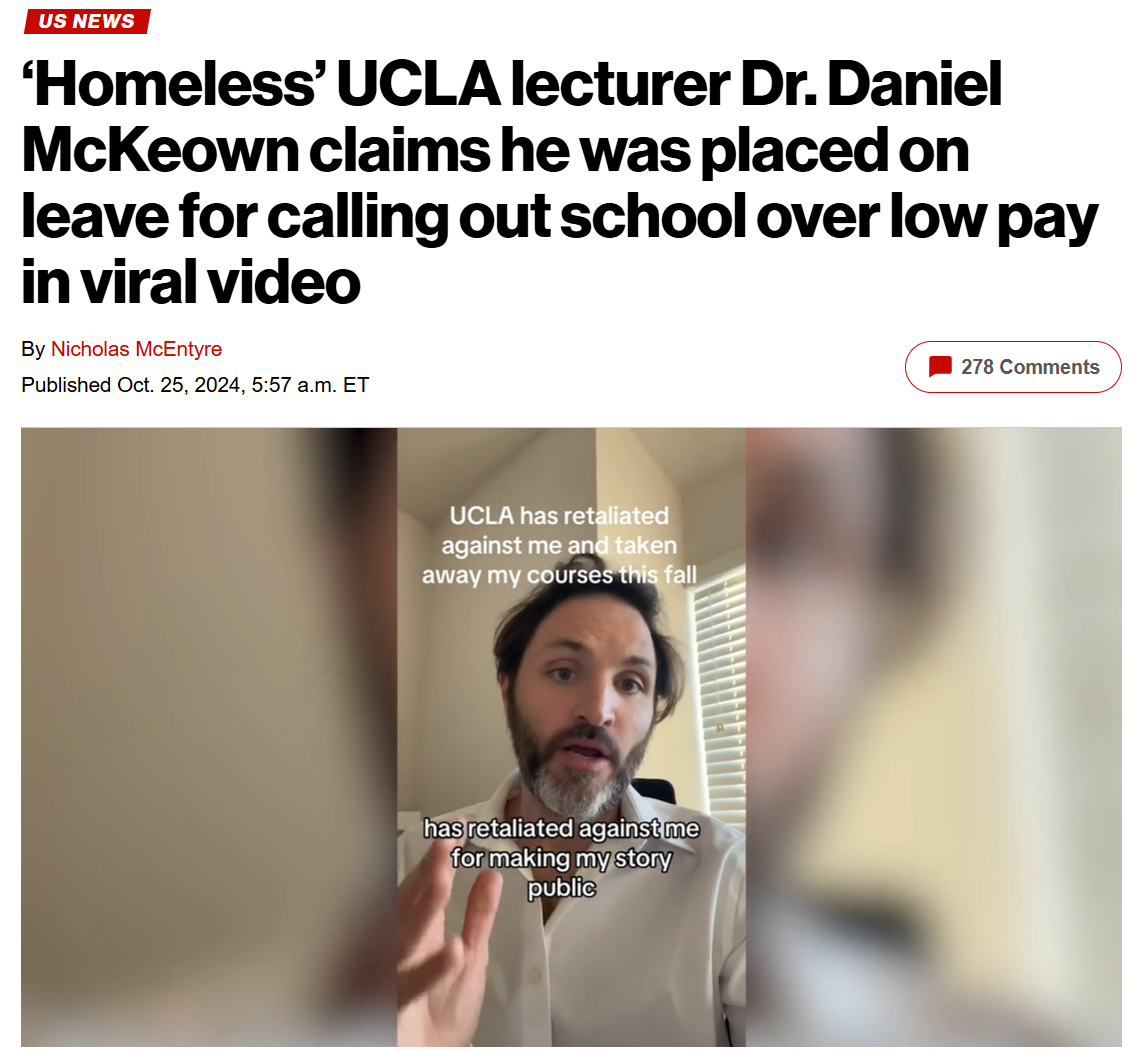
The story of the lecturer at UCLA in astrophysics who posted complaints about low pay continues to make the (media) rounds. We first posted about this matter on October 12. Now the story, somewhat updated, has reached the NY Post - see the image.*

As we noted originally, the story might have had more legal heft had the complaint been focused on lecturers more generally rather than about one individual, at least for PERB purposes. Indeed, there is no indication of union involvement.

Generally, the comments posted by readers of the Post were not favorable. None of the news stories get into the broader issue of the heavy reliance of universities on non-ladder faculty/temps of various types.

===

*https://nypost.com/2024/10/25/us-news/ucla-homeless-lecturer-dr-daniel-mckeown-placed-on-leave-for-calling-out-school-pay/.

Saturday, October 12, 2024

Lecturer Pay

From Patch newspapers:  A UCLA professor of astrophysics made headlines this week after releasing a TikTok video stating his low salary has rendered him homeless. Dr. Daniel McKeown asked his supporters to raise awareness about his salary and to lobby the school for change. In the video, McKeown said he earns $70,000 — not enough to afford an apartment in the affluent neighborhood surrounding UCLA. According to rental market research firm Zumper.com, the median rent in Westwood is $4,200, 111 percent higher than the national average. 

“Hi everyone, my name is Daniel, and I’m an astrophysics professor at UCLA. I’m only being paid $70,000 for this academic year to be a full-time professor, and the rent in Los Angeles is incredibly expensive,” McKeown says in the video...

Full story at https://patch.com/california/santamonica/s/izxug/ucla-astrophysics-professor-claims-low-pay-left-him-homeless.

Other news media have picked up the story. I checked the UCLA directory this morning and it does not list a Daniel McKeown, nor does the Astrophysics Dept. list him. (The fact that the Internet Archive is down due to hacking - see earlier posts on this blog - meant that I could not use the WayBack Machine to explore his work history at UCLA more fully.) However, it appears he was a lecturer in the past, based on internet searching. Whether he will be employed again is unknown. A labor lawyer would likely have advised him to advocate for lecturers in general rather just himself. A more collective complaint might have given him standing at PERB to complain about non-renewal of his contract, if that is what has occurred, in retaliation for concerted activity.

This episode does point to the increasing dependence of higher ed in general on what amount to temps, as oppose to better-paid ladder faculty, to teach undergraduates.

You can see the TikTok video below:

Or direct to https://www.tiktok.com/@danielastrophysics/video/7420110866860805419.

Tuesday, September 17, 2024

Rising Toward Parity

Source: https://regents.universityofcalifornia.edu/regmeet/sept24/f8.pdf

The chart above, available now to the Regents, indicates that faculty salaries are rising toward parity with the "Comparison-8" benchmark that is said to be recognized by the California Dept. of Finance. The Comparison-8 universities are shown below. 

Public universities:

University of Illinois, University of Michigan, University of Virginia, and SUNY Buffalo

Private universities:

Harvard University, Massachusetts Institute of Technology, Stanford University, and Yale University

Wednesday, April 24, 2024

Apples to Apples

UC is planning to embark on a "total remuneration" study of faculty pay, i.e., a study that compares the total value of salary and benefits with those of other universities. While salary comparisons are relatively easy, valuing the various benefits that are offered is more complicated. The Academic Senate is insisting that the survey be done using the same methodology as an earlier study done ten years ago, an apples-to-apples approach.

 ...The Senate believes that it is critical for the 2024 results for faculty be compared directly with the 2014 results to determine precisely how UC’s total remuneration competitiveness was affected by adopting the 2016 Retirement Tier and its PEPRA cap. The only way that a valid comparison can be made is to replicate the methodology used in the 2014 study. To fail to do so would confound the effects of retirement plan changes with changes in study methods, likely yielding erroneous estimates of the effect of retirement plan changes on UC’s competitiveness. The Senate will not accept the results of a confounded study.

Second, because the recruitment of outstanding faculty is more of a campus-based process than a systemwide process, the Senate has asked for a breakdown of total remuneration by campus. Divisional Senates want to know how their total remuneration has changed over the past ten years, not only relative to external peers, but also to other UC campuses. Again, no such valid comparisons can be made unless the methodology for the 2024 study mirrors the 2014 study, where data for each UC employee occupies a row of a spreadsheet...

Full statement at https://senate.universityofcalifornia.edu/_files/reports/js-cl-total-remuneration-study-2024.pdf.

The sentence saying the Senate won't accept a study with changed methodology is pretty definitive. If anyone was planning a change, all we can say is how do you like them apples?


Or direct to https://www.tiktok.com/@englishmakesnosense/video/7095855518572399915.

Monday, October 30, 2023

Rising UC Health Insurance Costs for 2024

Letter from Council of UC Faculty Associations to UC President Michael Drake and the UC Regents objecting to healthcare benefit costs to employees increasing by 22% to 193%, depending on plan and coverage.

President Michael V. Drake

Office of the President

University of California

1111 Franklin St., 12th Floor

Oakland, CA 94607

Delivered via Email to: president@ucop.edu

Dear President Drake,

Starting today, every UC employee received an Open Enrollment notice with new rates for healthcare benefits. UCOP presented these changes to UC Unions and the Council of UC Faculty Associations just three days before the start of Open Enrollment, leaving no opportunity for any input.

The increases in the employee health benefits share are unprecedented and alarming. Costs for healthcare benefits will be going up between 22% and 193% per month, depending on one’s plan and coverage. For example, if you currently pay for Kaiser for yourself and your spouse/partner, your cost will increase by 74% on January 1. Employees who insure themselves and their whole family (spouse/partner + children) through UC Health Savings Plan will see an increase of 171%. Every health benefit plan and coverage tier is affected, and these changes will impact the over 200,000 employees who receive benefits in the UC system.

Struck by the exorbitant increases, the UC unions and CUCFA pressed for answers. UCOP representatives cited inflation, deferred preventative care during the pandemic, rising drug costs, and clinical workforce shortages as root causes for these price increases. While these are all real issues impacting healthcare costs everywhere, when pushed for details about how prices were negotiated and set for UC employees, UCOP’s answers were unsatisfactory and lacked transparency.

For example, the cost to employees is determined by the insurance company rate increase less the employer share contribution. UC did not provide information about either the rate increase or the employer contribution, so there is no way to tell if UC is paying its share of the increased cost. But other sources indicate that Kaiser’s rate increase was probably about 15% this year[1], which would mean that UC reduced its share of contributions by about 20%.

We object to these unreasonable increases in our health benefit costs and UC’s secrecy and nontransparency in devising and announcing these policies. Your approach serves not only to degrade and disrespect UC’s academic employees but also contributes to the ongoing severe erosion of UC’s teaching and research mission. You will be hearing more from CUCFA, the UC unions, and the 200,000 people in the UC community who are now learning about how their lives and livelihoods will be devastated by the poorly warranted policy changes to our healthcare that UCOP has sprung on them.

Sincerely,

Constance Penley

President, The Council of UC Faculty Associations

Professor, Film and Media Studies, UCSB

===

cc: The UC Regents

===

Source: https://cucfa.org/2023/10/objection-to-unreasonable-increases-in-health-benefit-costs/.

===

PS from this blog: UC retirees under the various UC health plans also received notice of significant rate increases for 2024. It might be noted that the Medicare Choice (Medicare Advantage) option for retirees has particularly large increases. (Medicare Advantage is the privatized version of Medicare which now has more than half of all Medicare participants enrolled.

Monday, October 2, 2023

Going Up

From the Bruin: The UC Office of the President and UCLA Chancellor Gene Block approved a 4.6% raise for Academic Senate faculty. UCOP and the chancellor’s office evaluate the budget annually and decide whether to implement raises for the coming academic year. UCOP is responsible for determining faculty salary scales, and the chancellor’s office is responsible for allocating salaries for faculty members who are above the upper bound of the scale, said Andrea Kasko, the chair of the UCLA Academic Senate. The UCLA-specific 4.6% increase applies to ladder-ranked faculty members with salaries above the standard scale, the Academic Personnel Office said in an emailed statement. The 2023-2024 academic year raises will go into effect Oct. 1.

Faculty pay scales do not vary much across campus, but many faculty members also earn varying higher salaries than set by the scale, said Kasko, who is also a bioengineering professor. The increase will also apply to Health Sciences Compensation Plan faculty, Kasko added. UC staff employees also received a 4.6% salary increase, which went into effect July 1, according to a letter from UC President Michael Drake. However, this raise does not apply to unionized staff employees, whose wages are determined by collective bargaining agreements, Drake added in the announcement. Non-senate faculty members also will not receive the raise since they are typically part of a union that negotiates their salaries separately, Kasko added in an emailed statement.

Senate faculty members with salaries above the pay scale needed to complete the UC Preventing Harassment and Discrimination training course to be eligible for the raise, Kasko said, adding that this is the first time a requirement like this has been implemented. The course had to be completed by Sept. 1 to receive the raise by Oct. 1, according to the announcement by Vice Chancellor of Academic Personnel Michael Levine. Faculty members who complete the course after Oct. 1 would receive the raise starting on the date they completed the course, the announcement added. Block implemented the raise for above-scale faculty members in response to the increasing cost of living in Los Angeles, the chancellor’s office said in an emailed statement...

Full story at https://dailybruin.com/2023/09/30/uc-office-of-the-president-and-gene-block-approve-academic-senate-faculty-raise.

Wednesday, July 19, 2023

No train/No pay increase


From an email received today:

...The Chancellor and the Executive Vice Chancellor and Provost have directed that no discretionary compensation actions, such as the special 4.6% increase to the off-scale dollar increment, should be approved for ladder rank faculty unless they have completed the mandatory UC Preventing Harassment & Discrimination training by September 1, 2023. Ladder rank faculty who come into compliance after October 1, 2023 will have their off-scales adjusted as of the date the training is completed... 

Full memo at https://view.bp.e.ucla.edu/?qs=c5148d3aa2cae6f46b556fd6b3a859d91d1138f6d3bb6e52f1dc81ac132fdc11c46f589a044d10605098b3f534d7bde35c51ffd4dcc054a209ea2b048ff4f127472d3de1462b8cf103fb731b871d3df2.

Monday, May 15, 2023

If the pay increase for nonunion staff is going to be 4.6%...

...what will be the general increase for faculty? From Campus Human Resources:

In accordance with UC President Drake’s announcement regarding the FY 2023-24 Salary Program, the following guidelines are designed to assist departments in implementing the program for eligible staff. This program applies to policy-covered non-probationary staff in career, partial-year career, and eligible contract appointments. Student employees in casual-restricted positions and staff holding limited appointments are not included, nor are employees covered by a collective bargaining agreement.

In order to recognize the extraordinary efforts by our policy-covered staff members during these challenging times, the University is providing a 4.6% general increase to all eligible employees. Increases will be effective June 25, 2023 for employees on bi-weekly payroll and July 1, 2023 for those paid monthly. Accordingly, the new rates will be reflected in the July 19 or August 1, 2023 paychecks.

Although individual increases under this year’s salary program are not merit-based, the importance of the performance review process should not be discounted. All policy-covered staff must continue to receive performance reviews at least annually as required in Staff Personnel Policy...

Salary increases will be processed centrally by Campus Human Resources (CHR) or UCLA Health Human Resources (HHR).

---

Eligibility Criteria

Policy-covered staff appointed and on payroll by January 3, 2023, are eligible for the general increase except as noted in paragraph 2 below.

Contract appointees who are subject to PPSM 30: Compensation... under the terms of their employment contract are eligible for the general increase and for those who are not subject to PPSM, it is the responsibility of the department to notify CHR of the need for exclusion prior to the effective date of the increase. Contract employees at UCLA Health are not eligible for the increase as PPSM-30 coverage is no longer applied to any new or renewed contracts.

For Senior Management Group (SMG) employees, salary actions are in accordance with delegated authority established by the Office of the President and must be approved by the Chancellor, the President, and/or the Regents...

Full announcement at https://chr.ucla.edu/hr-administration/compensation-and-classification/2023-salary.

Note: The national Consumer Price Index (CPI-U) was up 4.9% for the twelve months ending April 2023. The Los Angeles CPI-U was up 3.8% over the same period. 

Sources: https://www.bls.gov/regions/west/news-release/consumerpriceindex_losangeles.htmhttps://www.bls.gov/news.release/pdf/cpi.pdf.

Friday, March 3, 2023

Total Pay

We're a bit late on this one. However, the Academic Council is calling on UC President Drake to conduct a "total remuneration" study of faculty pay and bring the results to the Regents at their July meeting. Total remuneration is the value of both cash pay and benefits such as pension and health care.

It might be noted that the breaking down of the pension plan into tiers based on entry date into the system in recent years makes such a survey more critical. There hasn't been such a survey since 2014.

To see the request, go to:

https://senate.universityofcalifornia.edu/_files/reports/sc-md-request-total-remuneration-study.pdf.

Thursday, December 8, 2022

Strike News: Additional Developments - Part 4

EdSource recently ran an article about delayed grading due to the student worker strike and its possible impact. We remind readers of our suggestion early on in this dispute that impasses can sometimes be settled through some form of arbitration.* Excerpt from EdSource:

The strike by University California academic workers may soon hit some undergraduates in a vulnerable spot: their grades. With the strike in its fourth week and no end in sight, faculty across the system are now planning to withhold tens of thousands of grades this fall in solidarity with those workers. That could have significant and dire implications for some undergraduates, such as those who need a certain grade point average to maintain federal financial aid and students planning to graduate this fall or soon apply to graduate school...

UC officials say very few students — maybe less than 1% of its 230,000 undergraduates — might have aid withheld if grades aren’t submitted on time and that the university is taking steps to mitigate those possible impacts. As of Tuesday, UC faculty have committed to withholding more than 30,000 grades until the strike ends. That number is based on self-reported information that faculty organizers have collected using an online form...

UC leadership has urged faculty to submit grades on time, even threatening to withhold pay if they don’t. In a recent letter to UC administrators, UC Provost Michael Brown wrote that faculty have the “responsibility to maintain course and curricular requirements,” including the “timely awarding and submission of grades.” He added that UC could “withhold their compensation” for faculty who “choose to withhold their labor during the strike.” ...

When it comes to financial aid disbursement, UC says fewer than 2,300 or so of its roughly 230,000 undergraduate students would be impacted. UC also plans to help those students in the event aid is withheld, including by offering UC-administered aid when a student can’t get federal aid...

Full story at https://edsource.org/2022/students-fear-losing-aid-as-grades-are-withheld-during-strike/682232.

===

*https://uclafacultyassociation.blogspot.com/2022/11/the-strike-if-it-drags-on.html.

===

To hear the text above, click on the link below:

https://ia601402.us.archive.org/25/items/big-ten/additional%204.mp3

Saturday, June 25, 2022

Proposal for supplemental faculty pay in STEM fields

The systemwide Academic Senate has under review a proposal for supplemental faculty pay in STEM fields similar to programs in the health fields. Comments on the program are due July 19th. Excerpts from the review document can be found below:

Our review of the NSTP [Negotiated Salary Trial Program] reveals that it is a program that is generally well received on the six campuses (Davis, Irvine, Los Angeles, Riverside, San Diego, and Santa Cruz) where it is used. Its utilization is somewhat limited, involving from just 1.0 to 12.3% of the faculty on any given campus (6.4% of all eligible faculty across the six campuses participate). Yet it provides considerable amounts of additional compensation to the participating faculty ($41,280 additional compensation on average among the participants and representing an augmentation of more than 20% of salary for 63.2% of the participants).

Survey results indicate that it is very popular with participants. Non-participants are more mixed in their attitudes toward it: some non-participants see it as a valuable way for the campuses to compete with other universities to attract and retain the best faculty; other non-participants see it as unfair and arguably at odds with the University’s ethos and mission.

As detailed below, the available evidence, while not perhaps as conclusive as might be desired, indicates that the NSTP is not harmful to the University’s mission. It does not appear to result in reductions in teaching nor in graduate student support. There is some evidence to suggest that it may even expand the research enterprise, thereby enhancing graduate and postdoctoral education. Clearly, at least in terms of pay, participants find the program beneficial. 

The open question is whether the program provides benefits in terms of enhancing faculty recruitment and retention. Arriving at a definitive answer for that question is challenging. There is no clear statistical or other quantitative evidence to say that the program does. At the same time, many participants and department chairs aver that the program has been an important component of attracting and retaining the best faculty. As we discuss below, we conclude that the program likely helps with keeping program participants at UC. The impact of the program on junior faculty recruitment appears to be minimal since they typically need several years to expand their research program to be able to participate. We note, too, that there appears to be little effect of the program on recruitment and retention for non-participants, who are the overwhelming majority of UC faculty... 

After considerable discussion and review of materials, the taskforce has concluded that ending the negotiated salary program would be so disruptive that we cannot recommend such a course of action. Rather, accepting that it needs to continue, we have addressed how it can be improved and expanded...

In the 2020-21 academic year, Federal contract and grants (C&G) provided the bulk of the funding support for the NSTP negotiated component, with significant contributions also coming from gift funds and private contracts and grants...


Source: https://senate.universityofcalifornia.edu/_files/underreview/nstp-tf-phase-2-report.pdf.

Wednesday, April 13, 2022

Note to the Regents: It's Hard to Ignore - Part 2

Yesterday, we noted that the Consumer Price Index was indicating significant inflation - with implications both for salary adjustments and pension adjustments.* Another index, the Producer Price Index (a successor to what was once called the Wholesale Price Index), is meant to suggest inflation in the "pipeline" that is coming toward retail prices. It was released today and it suggests there is indeed more in the pipeline to process, as the chart above shows. Put another way, there is more for the Regents to consider at their May meetings.

The latest PPI can be found at https://www.bls.gov/news.release/pdf/ppi.pdf.

===

*http://uclafacultyassociation.blogspot.com/2022/04/note-to-regents-its-hard-to-ignore.html.

Tuesday, April 12, 2022

Note to the Regents: It's Hard to Ignore

The latest reading on the Consumer Price Index is above. The 12-month figure is 8.5%. So-called "core" inflation, removing the effect of volatile food and energy, still gives you 6.5%. This information will have to factor into salary adjustments. We also noted in a prior post that the pension adjustment formula only partially reflects inflation above 2% per annum and that the Regents will need to be reminded of their "practice" of ad hoc adjustments for long-time pensioners who have suffered substantial erosion of their benefits.
Hard to ignore.

So far, the Federal Reserve has made only a modest upward adjustment of interest rates in response to inflation. It will be doing more in the future. What is now a booming economy in real terms - with labor shortages, etc. - could be tipped into a recession by aggressive moves by the Fed. Unlike the pandemic recession - which turned out not to have the expected major negative effects on the state (and thus the UC) budget - a more "conventional" recession would have negative effects.

The latest CPI news release is at:

https://www.bls.gov/news.release/pdf/cpi.pdf.