Pages

Thursday, July 23, 2020

Stall Warning - Part 2

There still are a mix of signs from the labor market concerning the economic situation in the face of rising coronavirus cases. At the national level, the number of new weekly claims for unemployment insurance rose and stands at 1.4 million for the week ending July 18. But the number of people receiving benefits fell. On an unadjusted basis, new claims were also 1.4 million. At the moment, the $600 supplement to UI is set to expire and it is unclear what Congress and the Senate will do - if anything - to prevent the lapse. California remains with a disproportionate share of those receiving unemployment insurance (16.7% in the prior week).

[Click on image to enlarge and clarify.]
The latest data are at https://www.dol.gov/ui/data.pdf.

Wednesday, July 22, 2020

U-Turn on Reopening Plans

Reopening plans at UC Berkeley, other campuses fall apart amid coronavirus surge

Teresa Watanabe, 7-21-20, LA Times

Hopes that college life might begin a slow return to normal this fall were deflated Tuesday, when two University of California campuses announced they would begin the semester with fully remote instruction amid a pandemic surge.

UC Berkeley and UC Merced had hoped to open Aug. 26 with a mix of online, in-person and hybrid classes. But they reversed those plans as COVID-19 infections began their record-shattering increases throughout California, with cases now topping more than 400,000 and deaths, 7,800. In Los Angeles County, half of new COVID-19 cases were among those ages 18 to 40...

“What you’re seeing is people having a great deal of respect for the power of this virus and doing everything they can to provide high-quality education in the safest way,” said Ted Mitchell, president of the American Council on Education, which represents more than 1,700 colleges and universities. “Nationally, people are beginning to pull back on the intensity of their in-person instruction.”

Most institutions will continue to offer some on-campus housing for those in need, such as students facing housing hardships or from other countries. Berkeley plans to make about one-third of its beds available, downsizing to single-occupancy rooms, and has issued about 3,200 housing contracts with space still available, campus officials said.

Glenn DeGuzman, Berkeley’s residential life director, said students considering whether to come to campus should talk to their families to make sure they are well-informed and comfortable with the risks and restrictions of doing so.

Students who choose to return to campus will be tested for COVID-19 within 24 hours of arrival and sequestered for 7 to 10 days, then tested again. They will be expected to refrain from outside contact except during essential tasks, such as getting food, and required to wear masks at nearly all times.

Those who violate the rules will be “held accountable,” with possible restrictions on access to buildings or services, DeGuzman said during an online campus conversation Tuesday.

To help foster connections during this isolating time, Berkeley plans to organize “social bubbles” of 10 to 12 students each who would be allowed to socialize with each other to create a “smaller family-like experience,” DeGuzman said.

UC Merced also has scaled back its planned reopening. The Central Valley campus had hoped to offer as many as 30% of its classes in-person but will begin fall term with fully online classes for at least the first four weeks. Merced also plans to fill less than 20% of its 4,000 beds with only certain students, such as those in financial or physical need.

The limited on-campus experience could hit Merced students particularly hard. Among UC’s nine undergraduate campuses, Merced educates the largest proportion of students who are low-income, 64%, and the first in their families to attend college, 74%. Buttressed by research showing that students who live together in small learning communities do best, Merced had instituted a two-year on-campus living requirement, but the pandemic has forced the university to waive it for the coming year.

UCLA, which does not begin its fall quarter until September, has not yet changed its goal to hold about 15% to 20% of classes in person and open some campus housing. USC announced this month it would scale down fall reopening plans and offer only 10% to 20% of courses in person...

Full story at https://www.latimes.com/california/story/2020-07-21/plans-for-partial-fall-reopening-shelved-at-uc-berkeley-merced-amid-pandemic-surge

Paid Family Leave Announcement

An announcement appeared on UCNet last week which yours truly missed. It is unclear how the paid family leave benefit described below will intersect for ladder faculty with current arrangements such as stopping the tenure "clock." It is also odd that this program was not discussed at the prior Regents meeting. There is also no mention in the announcement of negotiations about the benefit with unions for union-represented employees (which is a legal requirement under state law) prior to this announcement, although it is mentioned as something that will occur. Apparently, there hasn't been pre-announcement consultation with the Academic Senate. In any event, here is the announcement:

New paid family leave benefit approved for UC faculty and staff

Monday, July 13, 2020

UC's Council of Chancellors has unanimously approved a recommendation for a new paid family leave benefit for UC employees, effective July 1, 2021. This recommendation, supported by President Napolitano and Systemwide Human Resources, provides eight weeks of leave at 70% of wages for UC faculty and staff who need time off to care for a seriously ill family member or bond with a new child.

“The chancellors were in agreement that this is the right thing to do for our employees,” said Interim Vice President of Systemwide Human Resources Cheryl Lloyd. “Offering paid family leave adds the University of California to the list of other top employers that recognize how important it is to have family friendly policies and practices to recruit and retain the best.”

Systemwide groups that include the Systemwide Advisory Council on the Status of Women (SACSW), the Council of University of California Staff Assemblies (CUCSA) and the Staff Advisors to the Regents have been advocating for this important benefit for many years. The recommendation was developed by a cross functional workgroup comprised of members representing Human Resources, Academic Personnel, UC Legal, staff representatives and leadership, and is in alignment with the paid family leave benefit that is offered by the State of California.

Over the next year, Human Resources leadership, Academic Personnel and faculty leaders across the UC system, as well as other key stakeholders, will collaborate on the development of the new paid family leave benefit, finalizing details about how this new benefit will be implemented and how it will be coordinated with existing leave policies as well as paid family leave benefits already in place at some locations. This benefit is subject to collective bargaining for represented employees. We will keep the UC community informed before the July 1, 2021 effective date, as more information becomes available.

Source: https://ucnet.universityofcalifornia.edu/news/2020/07/new-paid-family-leave-benefit-approved-for-uc-faculty-and-staff.html

Tuesday, July 21, 2020

Not to worry

NOTE: Fall semester at Berkeley begins in less than a month.

From SFGATE: July 21, 8 a.m. UC Berkeley continues to see a trickle of coronavirus cases among staff and students after the university experienced a small outbreak at the start of the month. Officials said the situation is under control through testing and contact tracing.

"Contact tracing has been going very well thanks to the effort of university health services in coordination with Berkeley public health and the numbers are going in the right direction (slower rate of increase from that first week when we announced)," University Health Services spokesperson Janet Gilmore wrote in an email. "And individuals asked to come in and test are doing so."
Between July 1 and 8, the university detected 47 new cases and found the notable increase was likely tied to fraternity parties. A week later, between July 9 and 14, UC Berkeley's student health services discovered 25 more cases. Since then four new cases have been reported.

What Could Possibly Go Wrong - Part 3

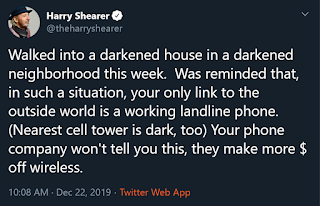
Loyal blog readers may recall our misgivings about the campus switching from landline (old fashioned) phone service to VoIP. But you would have to be really loyal and, in addition, have a very good memory, so we will remind you below. Links to our prior posts are also below.*

Back in the day of the 1994 Northridge earthquake, the landlines at UCLA continued to function even though the power was out throughout the LA region. Of course, that earthquake occurred at around 4:30 am, so there weren't a lot of folks on campus. (But recall that there were lots of folks in the hospital - as usual.)

The ongoing switch to VoIP on campus involves a complicated wireless arrangement. The state is still trying to get wireless providers somehow to guarantee that there won't be failures in an emergency, such as occurred during the Bay Area wildfires. See:

https://www.sacbee.com/news/california/article244347847.html

We also noted that the campus used to have - but appears no longer to support - a low-powered AM radio service for emergencies that covered the Westwood area. Even if you don't think you have a battery powered AM radio, if you have a car - or have access to a car - you have one. And earthquake kits often include a wind-up or battery powered radio.

Sometimes, simple is better.
===
*https://uclafacultyassociation.blogspot.com/2019/12/what-could-possibly-go-wrong.html
and
https://uclafacultyassociation.blogspot.com/2020/02/what-could-possibly-go-wrong-part-2_26.html

Our Kind of Donation

From time to time, yours truly likes to highlight donations that support teaching, research, and students at UCLA - as opposed to imposing structures. Here is one:

Alumna’s Gift will Support the Study of Contemporary Chinese Culture

A $250,000 donation from economics alumna May C. Chong has established the Heritage and Hope Endowment in the Department of Asian Languages and Cultures. Augmented by $125,000 from the Humanities Centennial Match, the gift will support students and faculty researching contemporary global Chinese culture and/or religion, specifically Buddhism.

“We are deeply grateful for May Chong’s generous gift, which will firmly embed contemporary Chinese cultural studies on our campus,” Dean of Humanities David Schaberg said. “More broadly, this gift further empowers UCLA in its mission to educate global citizens and foster greater cultural understanding.”

Chong, who graduated from UCLA in 1979, grew up in Hong Kong and immigrated to the United States after graduating from high school. As a student, she spent hours in the Richard C. Rudolph East Asian Library in UCLA’s Young Research Library, considering it her “home away from home.” In 2011, she established an endowment for the library supporting the acquisition of books and materials, including primarily Chinese classics, culture, education and modern literature, as well as publications in Chinese or dual language (Chinese-English)...

Full news release at https://www.college.ucla.edu/2020/07/13/alumnas-gift-will-support-the-study-of-contemporary-chinese-culture/

Monday, July 20, 2020

Drake's Cautious Answer on SAT/ACT

Incoming UC prez Michael Drake was cautious about answering a question on the use of the SAT or ACT for admissions on "Face the Nation" yesterday:

...MARGARET BRENNAN: Now that you're at UC, they have taken some high profile steps to attempt to increase diversity within the school system. One of the more controversial ones was this decision to do away with the requirement of SAT or ACT tests in the future, despite some arguments within the university that that doing so would result in lower grade averages or lower graduation rates. And I wonder how you think about addressing these concerns that- that eliminating the standard somehow lowers them?

DR. DRAKE: Well, we are in no way attempting to lower standards at all. We have a variety of things that we consider in admissions. I was admissions- in charge of admissions for the UCSF Medical School for many years and in the past. And we used a variety of things to determine the qualifications for students who are going to be admitted to our university. We're very proud that we have so many students interested in attending and we have to judge between them. And what we found is that standardized tests provide marginal information. They- they can help, but they don't tell the whole picture. And particularly in this time of COVID, when the- the opportunity to study and prepare for a test is quite uneven between those students who might be applying for us, we wanted to remove any potential barriers for students who might not have access to all the support that they need during this time to prepare for taking the test and therefore artificially score lower than they might. So the- the plan is to retreat from those standardized tests now and to think about other ways that we might gather that information as we look forward in the future. It's an ongoing discussion for us.

Full interview at https://www.cbsnews.com/news/transcript-dr-michael-drake-on-face-the-nation-july-19-2020/.

Note that Ohio State does require the SAT or ACT, although it has made the tests optional for this year due to the coronavirus sitution. See below from the Ohio State website:


Source: http://undergrad.osu.edu/covid-19-response/students-applying-for-autumn-2021#test-optional-faqs