Pages

Thursday, January 26, 2023

Still More on the Regents' Blackstone Lovefest

We have blogged about how chief investment officer Jagdeep Bachhar's deal to put $4 billion into Blackstone at a "guaranteed" 11.25%.* (UC already had a $2 billion investment in Blackstone.) 

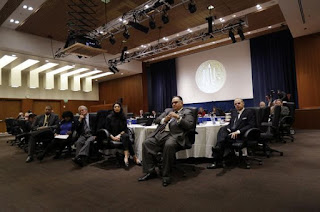
There were objections to Blackstone's record as a landlord at the Regents during public comments, but no regent questioned the idea of a guaranteed 11.25% by an institution that was experiencing a run on the bank. As we have repeatedly pointed out, no one nowadays gets a guaranteed 11.25% without risk. After a presentation by Blackstone on how good a landlord its real estate investment trust was, the Regents meeting turned into a lovefest. Turns out that the lovefest is continuing:

Blackstone Gets Extra $500 Million From University of California

By John Gittelsohn

January 25, 2023 - Bloomberg

The University of California is investing $500 million more into Blackstone Inc.’s massive real estate fund for wealthy investors, adding to a $4 billion commitment earlier this month. The new investment, which is expected to close March 1, will have the same structure, terms and fees as the university’s initial stake in Blackstone Real Estate Income Trust, according to a statement Wednesday. Those terms include a six-year lock up of the money, with Blackstone contributing $125 million to support a minimum 11.25% annual return. Blackstone built BREIT into a $69 billion real estate behemoth that owns properties from Las Vegas’s Bellagio hotel and casino to student housing and storage centers, helping expand the private equity firm’s reach with rich individuals. But BREIT came under pressure last year with more investors seeking to pull money out given the shift in markets, causing Blackstone to limit withdrawals from the trust in December for the first time...

Source: https://www.bloomberg.com/news/articles/2023-01-25/blackstone-fund-breit-gets-500-million-more-from-university-of-california.

===

You have to hand it to Jagdeep Bachhar; he knows his regental audience!

===

*https://uclafacultyassociation.blogspot.com/2023/01/watch-regents-investment-committees.html; https://uclafacultyassociation.blogspot.com/2023/01/more-on-blackstone-lovefest.html.

All is not well at the UCLA Lab School

First there was the recently-settled student-worker strike. Now comes the UCLA Lab School strike. From the LA Times:

For decades, UCLA Lab School, an elite pre-K-through-sixth-grade school nestled in a quiet corner of the UCLA campus, has offered a nurturing environment for students whose parents won a coveted spot for their child.

Run by the university’s School of Education and Information Studies as its hands-on education laboratory, multiple expert teachers curate lessons based on evolving practices. The student body is diverse, students are selected for admission, and tuition is up to $25,000 with about a third of students on financial aid, the school website says.

But the teachers — who welcome UCLA researchers into their classrooms, conduct studies themselves and report their findings to educators — have become dispirited over working conditions and went on strike Wednesday morning. Their public actions offer rare insight into long-simmering conflicts at a school dedicated to modeling the best practices in education...

The faculty, who are members of the University Council-American Federation of Teachers, say that UC management has violated their rights to bargain by delaying the process and denying them the right to negotiate a side letter that includes working conditions specific to the needs of a lab school. Teachers also say that the administration has made changes to the school’s practices, including extending the number of school days without their input or negotiation. The university is open only to negotiating salary, which is part of their primary contract, ratified in 2021.

On behalf of the teachers, the union filed an unfair labor practices complaint with the state Public Employment Relations Board in June. A hearing on the complaint is scheduled in spring. The university declined to comment on specifics of the negotiations. “We value the work of our UCLA Lab School Demonstration Teachers represented by UC-AFT. UCLA is negotiating in good faith with the union, and we are hopeful that an agreement can be reached soon,” the university said in a statement...

Full story at https://www.latimes.com/california/story/2023-01-25/ucla-lab-school.

The Regents at Riverside Tomorrow

Two committees of the Regents are meeting tomorrow at UC-Riverside off-cycle. Below is the agenda:

Agenda - January 27, 2023, UC-Riverside

9:45 am Special Committee on Innovation Transfer and Entrepreneurship 

Public Comment Period (30 minutes)

Action: Approval of the Minutes of the Meetings of September 20, 2022 and October 28, 2022

S1 Discussion: UC Riverside’s Role as An Engine of Economic Activity in the Inland Empire

S2 Discussion: Federal Update on the CHIPS and Science Act and its Impact on the National Science Foundation, University-Based Research and Technology Transfer

S3 Discussion: UC San Diego’s Migration from the Patent Tracking System: Opportunities and Challenges

S4 Discussion: Inclusive Innovation and Equitable Entrepreneurship (I2E2)

S5 Discussion: Speaker Series: UC Riverside Entrepreneur/Inventor Professor Masaru Rao

===

3:00 pm Public Engagement and Development Committee  

P1 Discussion: Regional Partnerships with UC Riverside

P2 Discussion: Initiatives to Address Health Inequity in Inland Southern California

P3 Discussion: UC Riverside Science to Policy Program (S2P)

===

Source: https://regents.universityofcalifornia.edu/meetings/agendas/jan272023.html.

Possible Return of Confucius?

As blog readers will recall, UCLA at one time had a Confucius Institute but discontinued it, along with those at most other universities, when there were pressures from the U.S. government and concerns about independence from the Chinese government.

According to Inside Higher Ed, there is now some possibility of such institutes returning:

Over the last five years, most of the Confucius Institutes hosted at American colleges and universities have closed down—but now a new report from the National Academies of Sciences, Engineering, and Medicine outlines a process for their potential return.

Whether U.S. colleges and universities would be interested in partnering with the Chinese government to host a Confucius Institute is unclear. The institutes started in 2004 as a way to provide Chinese language instruction and cultural programs to communities, K-12 schools and college students, but they came under scrutiny during the Trump administration from lawmakers who said the institutes were a national security threat. Faculty groups had been sounding the alarm about the threat to academic freedom before lawmakers got involved. As part of the Confucius Institute model, the Chinese government would provide instructors and funding, and the host institution would provide matching funds and in-kind resources, such as office space.

Gao Qing, former director of now-closed Confucius Institute U.S. Center, said he doesn’t expect to see a return of Confucius Institutes. The Confucius Institute U.S. Center served as the headquarters of the American network of institutes, and the State Department designated it a foreign mission of the People’s Republic of China in 2020. “The ground is poisoned right now, not only with the Confucius Institutes but also almost everything related to China,” Gao said.

Today, there are seven institutes—one of which will close in June—down from the peak of more than 100. Many colleges and universities opted to close their institutes after a change in federal law that barred institutions with Confucius Institutes from receiving Defense Department money. The department was able to exempt institutions from this prohibition but declined to issue the necessary waivers.

The National Academies report found that the CIs, as the institutes are widely called, can be beneficial to universities but do pose risks academic freedom, freedom of expression and research security. To mitigate those risks, the report recommended a set of criteria for waivers. The Defense Department sponsored the report, which was released this month. The Committee on Confucius Institutes at U.S. Institutions of Higher Education, made up of college administrators and professors, wrote the study.

...The proposed waiver criteria could be used starting Oct. 1 if the Defense Department decides to move forward...

Full story at https://www.insidehighered.com/news/2023/01/26/report-proposes-waiver-criteria-confucius-institutes.

The only remnant of UCLA's Institute is a Facebook page at https://www.facebook.com/UCLA.CI/. It hasn't been updated since 2018.

Notice: We Are Dropping the Text-to-Speech Option

As blog readers will know, back in August 2022, we began adding an option to hear the text of the blog as an experiment. 

The time involved in adding that option to each post and problems that have occurred with using archive.org to store the sound files have led yours truly to decide to discontinue the option as of today. We will, of course, continue using YouTube and archive.org links with sound for such purposes as recordings of Regents meetings.

Note that your computer probably has a text-to-sound option built into its operating system or available as a download. You can always cut an paste the text of the blog into that option and hear the text.

Wednesday, January 25, 2023

Sometimes No (US) News Is Good News - Part 13 (What's Up Doc?)

We previously reported that the Harvard med school was joining law schools - including at UC - in abandoning cooperation with the rankings provided by US News and World Report.* Now more med schools are joining Harvard. From the Washington Post:

Within the past few days, medical schools at the University of Pennsylvania and at Columbia and Stanford universities have declared that they would no longer provide U.S. News with data it uses to rank them. Their actions came after Harvard University’s top-ranked medical school on Jan. 17 announced a similar withdrawal from participation. As a result, four of the top 10 on the U.S. News list of best medical schools for research are on record in opposing the ranking process.

The rankings “perpetuate a vision for medical education and the future physician and scientist workforce that we do not share,” J. Larry Jameson, the dean of U-Penn.’s medical school, said in a statement Tuesday. He said the metrics U.S. News uses encourage schools to enroll students with the highest grades and test scores. “Yet, we strive to identify and attract students with a wide array of characteristics that predict promise,” Jameson said. “The careers of transformative physicians, scientists, and leaders reveal the importance of other personal qualities, including creativity, passion, resilience, and empathy.”

Hours after that statement, the 11th-ranked Icahn School of Medicine at Mount Sinai announced that it would no longer participate, either.

“I’ve been dean for 16 years, and I didn’t like living with the rankings,” said Dennis Charney, dean of the Icahn School of Medicine. The school almost made this decision more than five years ago, he said, but some people were concerned that it might affect their ability to recruit top students.

A similar dynamic unfolded in legal education after Yale University’s top-ranked law school renounced the U.S. News rankings in November. Many prominent schools followed Yale Law School’s lead...

Full story at https://www.washingtonpost.com/education/2023/01/24/medical-schools-revolt-us-news-rankings/.

===

*https://uclafacultyassociation.blogspot.com/2023/01/sometimes-no-us-news-is-good-news-part_19.html.

===

To hear the text above, click on the link below:

https://ia904704.us.archive.org/3/items/new-year-outlook/more%20med%20schools.mp3

It's Hard to Keep the Lid On

It's going to be hard for UCLA to keep the lid on this story now that it appeared yesterday in an article in Nature. There will be pressure to say something more than "privacy" or whatever prevents any comments. 

Scientists petition UCLA to reverse ecologist’s suspension

Sanctions on Priyanga Amarasekare have baffled supporters, who think they are retaliation for speaking out against discrimination.

by Jeff Tollefson

In April of last year, the Ecological Society of America awarded Priyanga Amarasekare one of the highest honours in the field of ecology: the Robert H. MacArthur Award. A little over two months later, the University of California, Los Angeles (UCLA), placed Amarasekare on a one-year suspension without pay or benefits, and forbade her from accessing her laboratory, maintaining her insect colonies, managing her grants or contacting students. Now scientists from around the world, who call Amarasekare a “highly distinguished ecologist”, “a committed teacher and outstanding mentor” and a “tireless advocate for under-represented groups”, are calling for her reinstatement.

The precise allegations that led to her suspension are unknown. UCLA has declined to release them, and barred Amarasekare from discussing the matter publicly. But long-standing tensions between Amarasekare and the university are no secret. A native of Sri Lanka and one of two women of colour who have tenure in the ecology and evolution department, she has previously accused the university of discrimination for repeatedly denying her promotions that were granted to colleagues. Former students and faculty members who are familiar with the situation think that Amarasekare’s suspension was retaliation for speaking out.

Some 315 scientists raised concerns about her suspension in a petition that was delivered to the university on 23 January, arguing that Amarasekare “has long been denied significant advancement within her department, out of keeping with her contributions to the field”. Moreover, the sanctions levied against Amarasekare — including the one-year suspension and 20% salary reduction for an additional two years — represent “the kind of punishment normally applied only to the most egregious wrongdoings”, including scientific misconduct and sexual harassment violations, the petitioners write.

In the absence of compelling evidence to the contrary, the scientists ask that UCLA rescind the disciplinary actions and fully compensate Amarasekare. Officials with UCLA say that the university “supports freedom of expression and does not condone retaliation of any sort”. They declined to discuss the accusations against or in support of Amarasekare, saying the university is “bound to respect the privacy of the numerous individuals involved in this matter”. Amarasekare also declined to comment.

Colleagues told Nature that Amarasekare is the rare ecologist whose research spans the theoretical, computational and experimental realms. One project in her laboratory that touches on all of these areas focuses on the impact of climate change on insect communities. “She’s really several years ahead of everybody else,” says Andy Dobson, an ecologist at Princeton University in New Jersey who led the petition. Dobson has written letters to support Amarasekare’s various applications for promotion at UCLA and says he has been baffled by the university’s decisions. “She complained, and most of what’s happened seems to be a reaction against that,” he says.

...As the recipient of the MacArthur award, Amarasekare is expected to discuss this research when she delivers her keynote address at the Ecological Society of America’s annual meeting in Portland, Oregon, in August.

Full story at https://www.nature.com/articles/d41586-023-00207-w.

The Bulletin of the Ecologicial Society describes a talk Amarasekare gave at an earlier conference:

In her talk, Priyanga Amarasekare from the University of California, Los Angeles, described herself as a woman with brown skin, an immigrant from a third-world country, and a single mother. She is also in a field, Mathematical Biology, in which women are underrepresented and women of color are rare, especially at the senior level. She has the lived experience of multiple overlapping identities, and the interdependent systems of discrimination and disadvantage that such identities entail. These experiences have given her the determination to help others navigate bias and make changes to prevent future bias. To do so, she has devised a three-step process: (1) identify the bias, (2) protect oneself from it, and (3) strive to make a change...

Full description at https://esajournals.onlinelibrary.wiley.com/doi/full/10.1002/bes2.2033.

In April 2021, we noted on this blog that Professor Amarasekare won a Guggenheim fellowship.* Since then, something happened. There is more to this story than the little that has leaked out. We await more information.

===

*http://uclafacultyassociation.blogspot.com/2021/04/ucla-faculty-win-8-guggenheim.html.

===

To hear the text above, click on the link below:

 https://ia904704.us.archive.org/3/items/new-year-outlook/lid%20on.mp3